


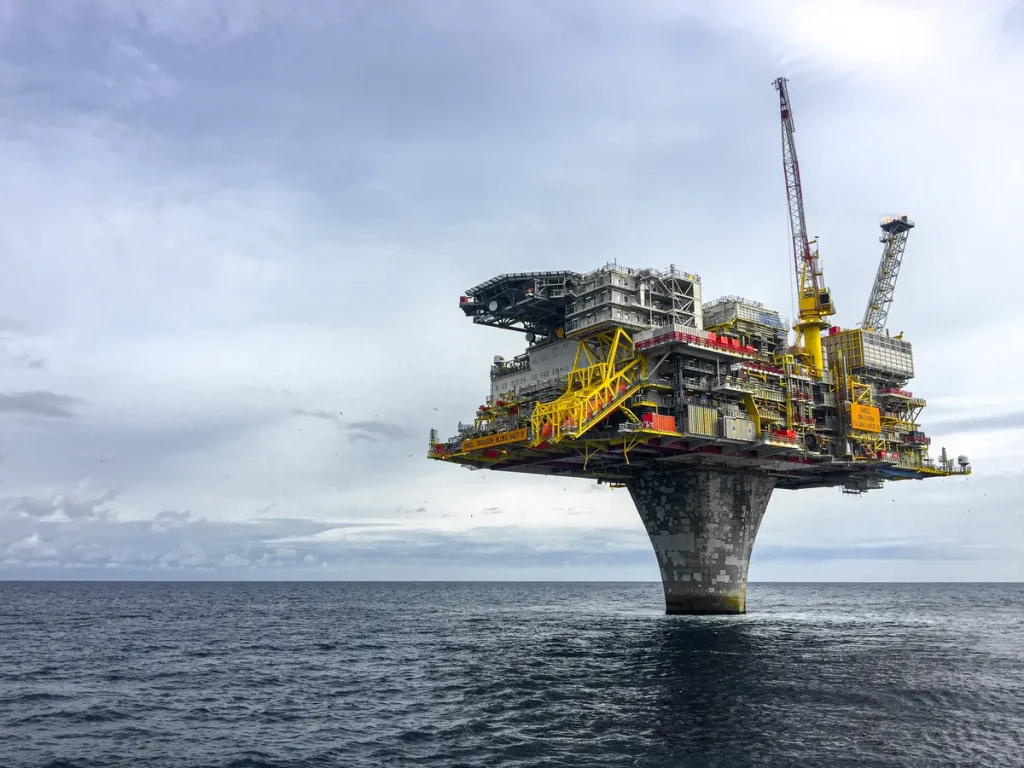

The Rockhopper Exploration share price plunged as much as 10% at the open in London after Argentina’s president Javier Milei threatened sanctions against oil companies operating near the Falkland Islands, calling the Sea Lion oilfield a ‘clear and present danger.’
The Rockhopper Exploration share price had settled to 71.1p by mid-morning, having touched a two-month low at the start of trading. The market reaction was swift: any sovereign threat to drilling rights in contested waters carries a premium of fear, and Milei supplied it in quantity.
What Milei Actually Said
In a national television address, Milei told viewers: ‘Argentina will not stand idly by. Any further advance on the Malvinas Islands will be considered a violation of our national security.’ The language was that of military doctrine, not diplomatic protest, and markets priced it accordingly.
The Sea Lion project sits approximately 220 kilometres (140 miles) north of the Falklands. Navitas Petroleum holds a 65% working interest in the field and acts as operator through its UK subsidiary, Navitas Petroleum Development and Production (NPDP). Rockhopper holds the remaining 35% stake.
Rockhopper Exploration Share Price Pressure Meets a Project Already in Motion
Milei’s intervention is poorly timed from Argentina’s perspective, in the sense that Sea Lion is no longer a speculative proposal. The Northern Development Area Phase 1 was formally sanctioned on 10 December 2025, according to a London Stock Exchange announcement filed by Rockhopper. First oil is now scheduled for March 2028, with production expected to run for more than 30 years.
The reserves make the prize plain. Navitas Petroleum attributes 216 million barrels of oil equivalent to Sea Lion on a 2P (proved and probable) basis, rising to 603 MMBOE on a 2C (contingent resources) basis. Those are not numbers that either party walks away from lightly.
Rockhopper discovered oil at Sea Lion in 2010, so the project has been 15 years in the making. Clearing the Final Investment Decision required Rockhopper and the Falkland Islands government to resolve a long-running tax dispute: according to Offshore Energy, Rockhopper agreed to pay a previously contested tax liability from a 2012 farm-out to Premier Oil in instalments totalling £30 million on an undiscounted basis, with the settlement also covering any liability arising from the 2022 farm-out to Navitas.
The capital is committed, the tax settlement is concluded, and the drilling timetable is confirmed. This is a project mid-stream, not one awaiting permission to begin.
Expansion Plans Already Under Way
Milei’s threat lands against a backdrop of active expansion beyond Sea Lion itself. Navitas has signed a non-binding memorandum of agreement with JHI Associates to farm into the adjacent PL001 North Falklands Basin licence, acquiring a 65% working interest in that block, according to MercoPress. Eco (Atlantic) Oil & Gas holds a 6.6% interest in the PL001 licence through its stake in JHI Associates.
Offshore Energy has also identified upside beyond Phase 1: the Isobel-Elaine oil discovery to the south of Sea Lion could be developed under future project phases. The project’s ambitions are moving in one direction; Argentina’s rhetoric is attempting to move them in the other.
NPDP plans to run Sea Lion operations from offices in London, Aberdeen, and Stanley in the Falkland Islands. Onshore British jobs and supply-chain contracts are therefore embedded in this offshore geopolitical dispute, which constrains how passively London can respond.
Where the Risk Actually Sits
Whether Milei’s rhetoric translates into concrete legal action against operating companies is the question the market is circling. Argentina has long-standing sovereignty claims over the islands it calls the Malvinas, but sanctions targeting a Falkland Islands-licensed project would face serious jurisdictional complexity. The UK government would not be a passive observer.
My read is that the Rockhopper Exploration share price move reflects uncertainty, not a fundamental reassessment of Sea Lion’s viability. The project cleared its most difficult procedural hurdle in December; the reserves are substantial; the partners are committed. If Buenos Aires moves from speeches to formal sanctions, the calculus changes materially. Until then, at 71.1p, RKH is pricing in a risk that may never arrive.
