



Contributed content: this article was written by a third-party contributor and does not necessarily reflect the views of Columnist24. Editorial and Advertising Policy
A resident of Cream Ridge, NJ, Edward Granaghan is a travel and fitness enthusiast. One of the foundational aspects of staying in shape is integrating “explosive” exercises into the daily workout routine. Also known as plyometrics, these are designed to get the muscles operating in bursts, generating force quickly. Gaining this kind of speed of movement involves harnessing the force of gravity, whether through throwing, jumping, or performing a push-off from the ground.
Examples of plyometrics are as varied as running across the street, catching oneself as one starts to fall, and getting out of a chair. Unfortunately, muscle power begins declining at an accelerated rate in the 40s. This is no small matter, as it ties into coordination, balance, and bone density. Maintaining muscle power is a key predictor of one’s ability to live independently and safely in advancing age.
Beginners at plyometrics focus on simple, repetitive moves, with the landing element most important. One basic move is the drop squat. From a standing position, feet flat and legs around hip-width apart, one raises oneself onto tiptoes, holding the position for a few seconds, arms overhead. Suddenly and with force, the arms are brought down in a sweep, and at the same time, the individual drops into a squat position and holds it.
In a simple, low-risk way, this teaches the body to anticipate sticking the landing on a jump. Another benefit is teaching runners how to properly absorb the force of the intense load encountered each time the foot hits the pavement.
A more advanced plyometric move is the pogo jump, performed on one or two legs. Here, the hands remain static below the waist, while the feet repeatedly jump, using the momentum provided by each ground impact to lift off. The exerciser bounces on the balls of the feet, which provides practice in absorbing force.
From here, one may start working with boxes that add height. For example, with the depth drop, the individual stands on a box around eight to 12 inches off the ground. Simply stepping off the box generates plyometric motion, as the feet work to stick the landing. This provides the body with low-intensity training on how to absorb added force from height. Redistributing such forces and load helps prevent joint and muscle harm.
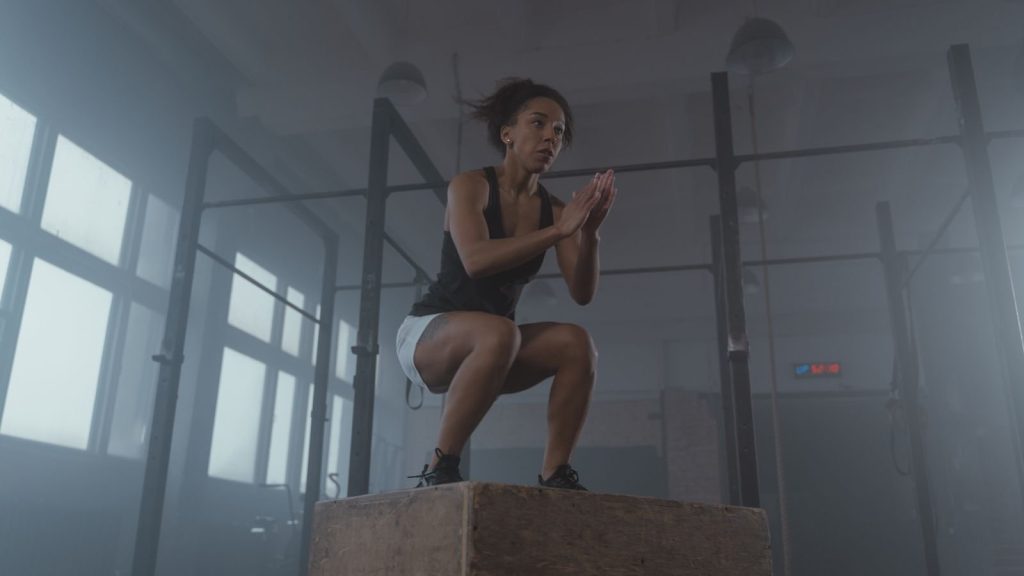
From here, many progress to higher-intensity movements involving greater forces. These types of exercises can lead to injuries if performed without proper technique. For this reason, it’s best to start with body-weight exercises such as single-leg jumps, tuck jumps, and forward squat jumps. The latter involves sweeping the arms back as the knees bend slightly. As the arms come forward in a fluid motion, the practitioner makes a jump with both feet parallel, maintaining balance through a “windmilling” of the arms up and down. The most advanced stage of plyometrics involves jumping over hurdles and box jumps, which are two-legged jumps from a standing position onto a box.
The key to plyometrics is limiting them to one or two sessions a week, with any lingering soreness allowed to work itself out. They should be performed at the start of the regular workout: their uniquely fatiguing, draining, and explosive nature makes being fresh and alert essential. Within the context of a full workout, plyometrics mesh well for people like Edward Granaghan with other anaerobic routines, such as strength training.
