


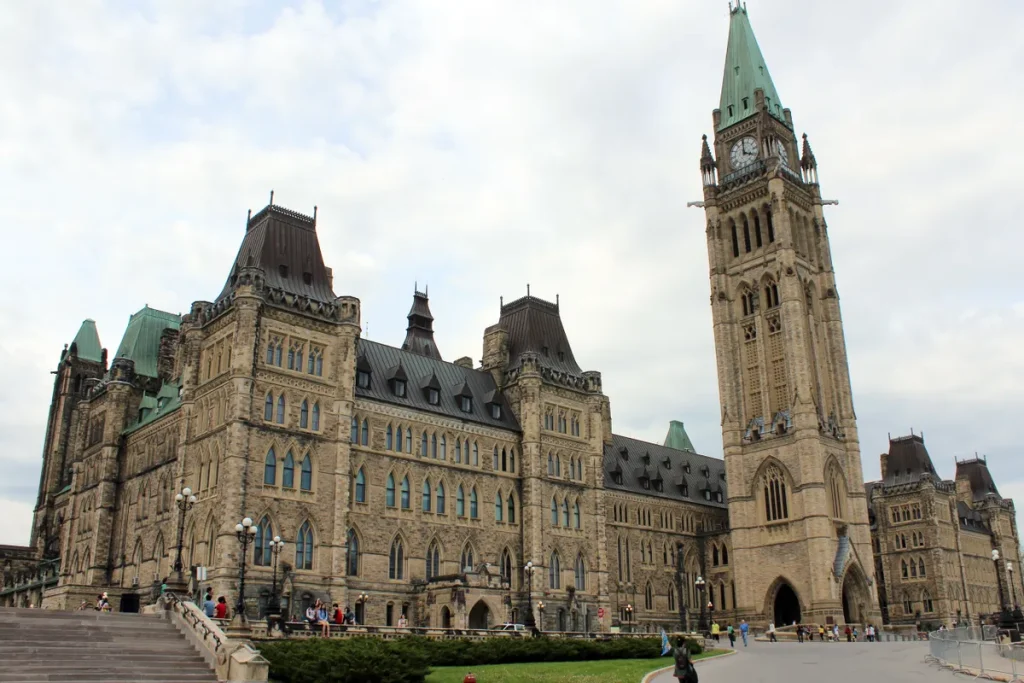

The Canada-EU associate membership proposal is, for now, a political hypothesis without a treaty, a legal framework, or even a shared definition. But as hypotheses go, this one carries more structural weight than most, and it holds an uncomfortable mirror up to Britain.
When European Commission President Ursula von der Leyen used her 2026 State of the Union address on 16 September to invite Canada into the highest tier of partnership the EU has ever offered a non-member, the chamber gave her a standing ovation. Mark Carney, seated in the front row as a guest of honour, rose to embrace her. According to Politico EU, the proposal caught many EU member countries by surprise. That detail matters: von der Leyen moved faster than her own bloc expected, which says something about the urgency she attaches to the project.
What Canada-EU Associate Membership Actually Means
Nobody has fully defined it yet. Carney himself did not use the phrase in his subsequent European Parliament address, preferring instead an ‘alliance for the future’ that would create a ‘beacon for other democracies,’ according to Horizon Weekly. The distinction is deliberate. A senior Canadian official familiar with the discussions told European Interest that Canada was seeking an arrangement allowing Canadians to reside and work in Europe without visas, and that Ottawa explicitly did not intend to replicate the Norway or Switzerland models. In other words: something genuinely new.
The architecture being assembled underneath the rhetoric is already more substantial than the headlines suggest. Canada signed the Canada-EU Security and Defence Partnership on 23 June 2025 at the 20th Canada-EU Summit, opening cooperation across Ukraine, crisis management, military mobility, defence procurement and cyber, according to the Government of Canada. On 14 February 2026, ahead of Carney’s parliament address, Canada signed an agreement on participation in the EU’s Security Action for Europe (SAFE) programme. Carney appointed John Hannaford as his Personal Representative to the EU on 1 October 2025, a newly created role, to lead on trade, economic security, climate and defence collaboration.
This is not mood-boarding. This is scaffolding.
Von der Leyen’s speech went further still, proposing that the EU and Canada ‘step up together’ on AI model evaluation, verification, early warning and AI security, and flagging her intention to convene the main frontier AI labs to advance that agenda. Carney’s complementary offer is concrete: Canada brings major energy reserves, critical minerals, growing artificial intelligence and quantum technology capacity, and a strategic Arctic position, as Horizon Weekly reported from his parliament speech.
The Trump Factor and What It Means for Britain
The economic pressure driving all of this is not subtle. Approximately 70% of Canadian exports currently go to the United States, according to European Interest. After US-Canada trade talks collapsed, Trump imposed 50% tariffs on $20 billion of Canadian goods, with Carney retaliating on a roughly equal volume of US products, the Irish Independent reported. Trump’s response to the Canada-EU rapprochement has been characteristically blunt: he warned of ‘very heavy tariffs on Europe’ if the partnership proved economically unfavourable to the US, called Canada a ‘terrible trade partner,’ and described the prospect of Canada joining the EU as ‘laughable,’ according to the Economic Times.
Carney’s response to that pressure is to name it clearly. He talks about a ‘rupture’ in the international order and the specific challenge facing middle powers in a world shaped by US-China rivalry. His prescription is maximal cooperation among democracies that still believe multilateral alliances and reciprocal obligations can yield mutual benefit. That clarity of diagnosis is what makes the Canadian pivot coherent rather than merely reactive.
Britain is in a structurally similar position: exposed to Trump’s tariffs, reliant on a US security relationship that has become conditional, and geographically and economically bound to the European continent. The difference is that Sir Keir Starmer is still trying to manage the residue of a Brexit deal engineered to pull the two sides apart, operating under a trust deficit that Canada does not carry. Reorienting from within that constraint demands more political imagination than has so far been on display.
Carney has shown that a middle power with a clear geopolitical thesis and methodical groundwork can move fast when the moment demands it. The question for London is whether the moment will be allowed to pass before anyone in Westminster works out what thesis they are actually operating on.
