


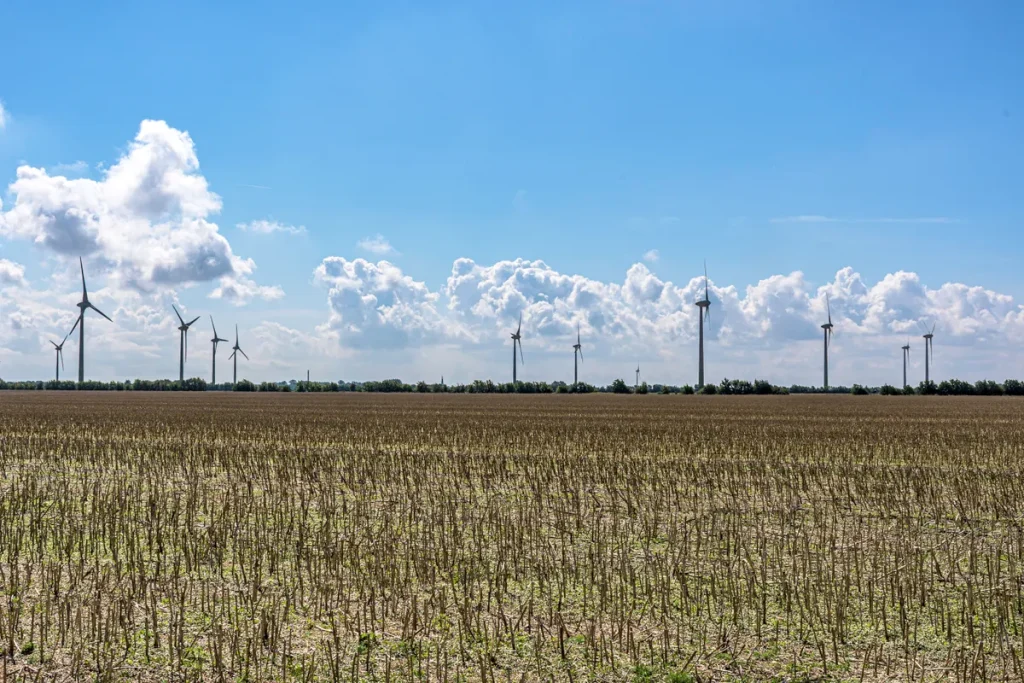

Brazil wind farm communities in the north-east are living inside a paradox: they host the turbines powering the country’s ambition to become the world’s leading green energy exporter, and they are paying for it in lost crops, broken health and contracts they can no longer audit.
Brazil has about 35GW of onshore wind capacity in commercial operation, the fifth largest in the world, according to the Brazilian Association of Wind Energy and New Technologies (ABEEólica) and the Global Wind Energy Council. Nine in ten of those turbines stand in the north-east, where the winds are the strongest and the social indicators are among the country’s worst.
The convergence was supposed to trigger a redistribution of wealth. It has not worked out that way.
What Brazil Wind Farm Communities Were Promised
In Serra do Mel, in Rio Grande do Norte state, farmer Antonio de Souza signed a contract with French renewable energy company Voltalia after a year of drought. The promise was a monthly income of 3,000 to 5,000 reais (£430–£720), adjusted annually, without harming his crops. A decade on, cashew trees have been cleared beneath power lines, four hectares of a 50-hectare family plot are effectively wasteland, and cattle are forbidden from grazing near the cables.
The Serra do Mel complex has grown into a 502MW installation across 40 wind farm projects, of which 36 are operational, running 360 individual turbines, according to the Lavoro Institute’s report on Brazil’s energy transition. The first turbines began generating in 2015.
The payments to landowners are set at 1.55% of turnover, calculated against wherever the energy is sold. Data from the National Electricity Agency (Aneel), compiled by the Lavoro Institute, shows that 17 of the Serra do Mel power stations sell all of their electricity on the open market, mostly to consumers in Brazil’s south-east and central-west at negotiated prices. The electricity that lights Serra do Mel itself costs residents twice as much.
The health data tells its own story. Figures from Brazil’s Primary Healthcare Information System (Sisab), also compiled in the Lavoro Institute’s report, show a rise in complaints of anxiety, panic disorders, sleep disorders and hearing problems in Serra do Mel from 2022 onwards, when most of the municipality’s 36 wind farms came into operation. In the comparable municipality of Poço Branco, which has no turbines, the trend moves in the opposite direction.
Relvani de Brito lives 250 metres from a turbine. France requires such equipment to be at least 500 metres from homes. Brazil has no federal minimum-distance regulation. ‘At night it’s worse because everything is quiet, and that’s when the racket starts,’ she says. ‘I take medication for anxiety. I don’t sleep at night; I wake up at one o’clock, right on the dot.’
Legal Pressure Mounts Against Voltalia
A public civil action was filed on 21 May 2025 by three rural workers’ organisations, seeking compensation for health problems and unfair contracts, suspension of four wind farms still under construction, turbine relocation, and a corrective environmental impact assessment. A separate complaint, brought by FETARN, CUT-RN and the NGO SAR and accepted by Brazil’s Ministry of Human Rights and Citizenship, seeks mediation for alleged non-compliance with the OECD Guidelines for Multinational Enterprises, according to Windpower Monthly.
Voltalia said it had not been served the lawsuit, that it complied ‘strictly with Brazilian legislation’ and that its wind farms were ‘managed in accordance with applicable regulatory, social, environmental, and health and safety requirements’. It denied the projects caused damage.
The people of Serra do Mel are not asking the company to leave. They want to understand what their land actually generates, to receive what they were promised, and to keep the social security status that allows rural workers on family farms to retire as farmers, a status now at risk because the land they signed over can no longer be worked.
Offshore Expansion and a Grid Already Under Strain
The same coast that gave Brazil its onshore boom is now set to host its first offshore turbines. In June 2025, the federal environmental agency Ibama issued Brazil’s first preliminary licence for an offshore wind project off Areia Branca, near the salt terminal that is the main distribution point for Brazilian salt. The pilot project foresees two turbines installed around 20 kilometres offshore; Brazil Energy Insight reports a combined capacity of 22MW, while New Energy Events puts the figure at 24.5MW; the two sources conflict and neither figure should be treated as definitive. A further 104 offshore projects with licensing requests are waiting at Ibama, totalling 247.3GW of proposed capacity.
Whether the grid can absorb that ambition is a legitimate question. Brazil wasted 20.6% of the wind and solar energy it could have generated in 2025, with S&P Global recording a figure of 20.7% for the same period, reflecting rounding or methodological difference. Windpower Monthly estimates that 28 TWh of wind power was lost to curtailment in the first eight months of 2025 alone. The sector association’s president, Elbia Gannoum, called it the worst crisis in the history of Brazilian wind energy, and losses have been estimated at more than 6bn reais.
My read is that the curtailment figures are the most damning rebuttal of unchecked expansion: the north-east is already generating more renewable energy than the grid can carry, yet the licensing pipeline keeps growing.
The fishing communities around Areia Branca were largely unaware of what was being planned offshore when a human rights monitoring group visited them. They say the towers will be erected where they work. Brazil’s government has a decision to make about which constituency it is building this energy future for. On current evidence, it is not the people standing closest to the turbines.
