


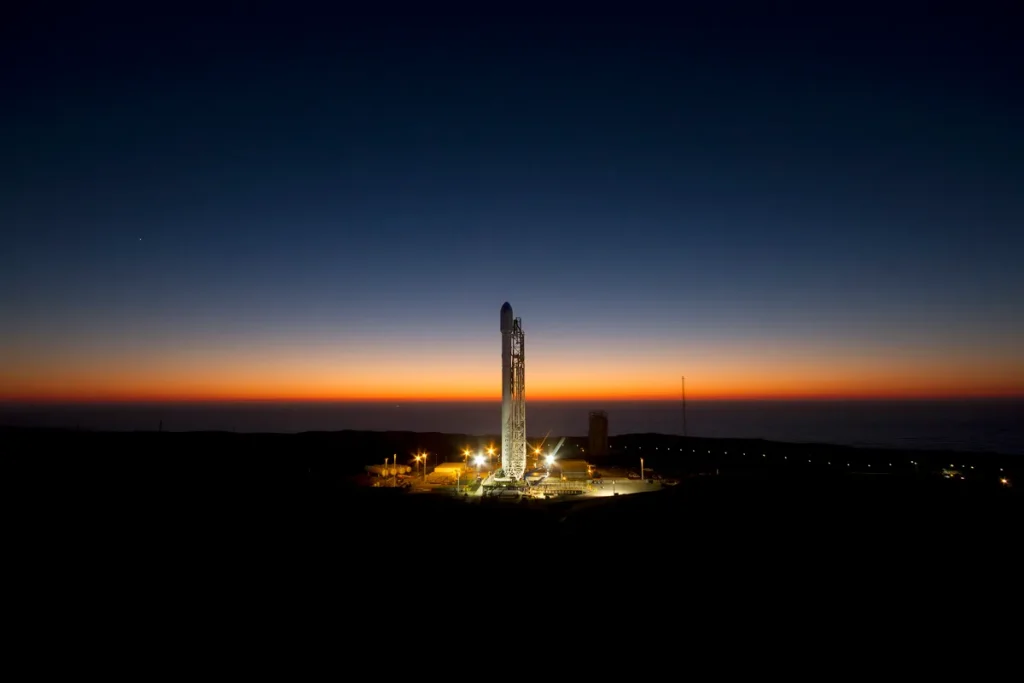

The SpaceX IPO share price of $135.00 begins trading on the Nasdaq today after the company raised $75bn in what is already the largest IPO on record, valuing the rockets-to-satellites-to-AI business at Reuters-confirmed $1.77 trillion. Morningstar thinks the shares are worth $63. That gap is the story.
SpaceX sold 555,555,555 shares of Class A common stock at $135.00 each, drawing orders for more than three times the amount on offer, according to the Financial Times. Demand came from both institutional and retail investors, the latter potentially boosted by SpaceX’s reported consideration of allocating as much as 30% of the offering to individual investors, an unusually large retail tranche aimed at broadening ownership.
Underwriters hold a 30-day over-allotment option to purchase an additional 83.3 million shares. If exercised in full, that would generate a further $11.25bn, taking total proceeds to roughly $86bn, according to SpaceNews.
What the SpaceX IPO Share Price Actually Reflects
At $135.00, investors are paying 92 times last year’s revenues. That is a number that demands scrutiny, not faith.
SpaceX reported $18.7bn in revenue and a net loss of more than $4.9bn for the full year 2025. In just the first quarter of 2026 alone, revenue reached $4.7bn, but the net loss for that single quarter was nearly $4.3bn. The losses are accelerating even as the top line grows.
In a June 1 research note, Morningstar placed a total company valuation of $780bn on SpaceX, 48% below its private-market valuation at the time, as reported by Reuters. Its per-share fair value estimate of $63 represents a 53% discount to the IPO price. Morningstar’s Michael Field, the firm’s chief equity strategist, has advised investors to wait for ‘a more attractive entry point down the line’, warning of ‘a major disconnect between market expectations and underlying fundamentals’.
The scepticism runs deeper than headline valuation. SpaceX claims a total addressable market of $1.6 trillion for Starlink alone. IFA Magazine‘s summary of Morningstar’s analysis puts the realistic global Starlink opportunity at approximately $129bn, a figure that would materially change the growth arithmetic. Morningstar assigns only a 7% probability to its most optimistic scenario, which requires both rapid Starship reusability and highly successful orbital data centres.
SpaceX itself has pitched investors on a $28.5 trillion total addressable market, tying much of its growth to AI and plans for solar-powered data centres in space. Whether you find that visionary or a reason to back away slowly probably tells you more about your risk appetite than about the business itself.
Musk’s Control, the Lock-Up Overhang, and What Comes Next
The dual-class share structure SpaceX filed in its S-1 registration statement with the SEC on 20 May 2026 gives Class B shareholders the right to elect a majority of the board. Class A and Class B shareholders otherwise vote together as a single class.
On 13 January 2026, SpaceX’s board approved a grant of 1 billion performance-based restricted shares of Class B common stock to Musk, and he retains the right to vote all of those outstanding shares. That is a governance structure that concentrates control firmly in one person, regardless of how today’s trading goes.
There is also a supply overhang to consider. Shares subject to an extended lock-up period, together with Musk’s own shares (subject to a 366-day lock-up), represent approximately 7.8 billion shares, or more than 60% of SpaceX’s shares outstanding immediately prior to the offering, according to the SEC filing. Augustus Wealth notes that a five-for-one stock split in June 2026 re-based share counts ahead of listing. When those lock-ups expire, the float will change dramatically.
My read is that the demand today will probably push the SpaceX IPO share price well above $135.00 in early trading. Oversubscribed IPOs from trophy companies almost always pop. The harder question is whether anyone buying at $200, $250, or beyond can construct a sensible path to fair value when Morningstar’s bull case, the one assigned a 7% probability, still only justifies $63. The lock-up expiry in mid-2027 is the first real test of whether this market believes the story or was simply chasing the name.
