


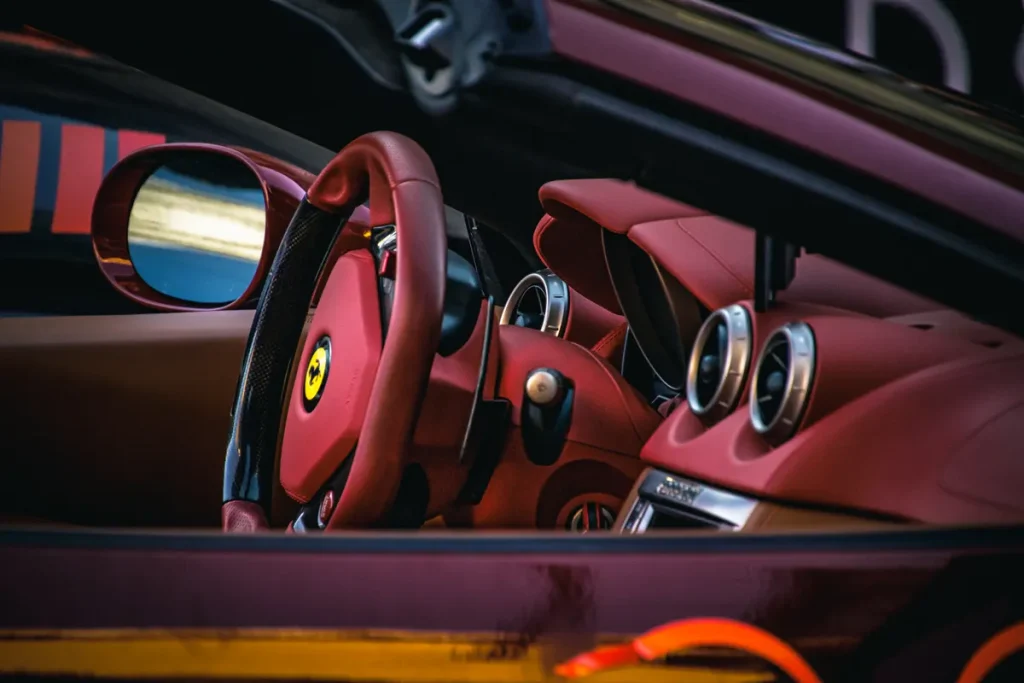

The Ferrari marketing boss quits story has a timing problem that the company’s carefully worded statement cannot quite paper over. Enrico Galliera, who has held the role of chief marketing and commercial officer for 16 years, is leaving the Maranello firm just weeks after the unveiling of the Luce, its first fully electric car, triggered a wave of mockery, memes, and a 8% single-day share price drop.
The Luce backlash and what followed
Ferrari unveiled the Luce in May to a reception that was, by any measure, rough. The car’s design, created in collaboration with former Apple chief design officer Sir Jony Ive, drew criticism from some of the most establishment voices imaginable: Ferrari’s own former chairman, and Italy’s deputy prime minister and transport minister Matteo Salvini.
The $640,000 (£485,552) price tag did not insulate it from ridicule. Internet memes proliferated. Shares in Ferrari fell sharply the day after the launch.
Ferrari’s statement on Galliera’s departure made no mention of the Luce. Chief executive Benedetto Vigna said Galliera ‘has played a significant role in the company’s growth and in strengthening the Ferrari brand worldwide’ and that he ‘has the gratitude of the entire Ferrari team and my personal best wishes for the future.’ The company added that Galliera had ‘decided to embark on a new chapter in his professional journey, a decision shared with the company some time ago.’
That last phrase is doing considerable work. It signals the departure was not impulsive. It does not explain why this particular moment is when the news surfaces.
Who replaces him, and what his Ferrari marketing boss exit means
Galliera’s successor is Massimiliano Di Silvestre, previously President and CEO of BMW Group Italy, a more senior title than some early reports suggested. According to Ferrari’s official announcement, Di Silvestre brings more than twenty years of leadership experience in the premium and luxury automotive sector.
His appointment is effective 1 July 2026. In the new role, he joins Ferrari’s Leadership Team and reports directly to Vigna, according to the same announcement.
The choice of a BMW veteran is worth noting in context. BMW has spent years navigating the shift to electrification while defending a premium positioning, exactly the tension Ferrari now faces. Whether Di Silvestre’s experience translates to a brand where exclusivity has always been the product is a question the market will be watching.
Ferrari filed the announcement with the Securities and Exchange Commission (SEC) as a Form 6-K on 23 June 2026, viewable via Ferrari’s Form 6-K filing. The company’s shares trade on the New York Stock Exchange (NYSE) under the ticker RACE, and have been listed there since 2015.
Galliera joined Ferrari in 2010 and has been present for much of the company’s modern era. He was there for the 2013 launch of the LaFerrari, the firm’s first production hybrid hypercar. He was there when the company listed in New York in 2015 and in Milan the following year. His role carried real commercial weight: he managed which clients were eligible to purchase Ferrari’s most sought-after vehicles, a function that sits at the heart of the brand’s scarcity model.
Sixteen years of that institutional knowledge walking out the door at this particular moment is the kind of thing that needs more than a press release to explain fully.
My read is that Ferrari faces a more complex identity question than any single executive departure can resolve. The Luce was always going to be divisive; an electric Ferrari challenges the very thing customers are paying for. Whether Di Silvestre arrives with a mandate to soften the EV push, accelerate it, or simply sell it better, we do not yet know. The next product cycle, and how Ferrari positions it, will be the real answer.
