


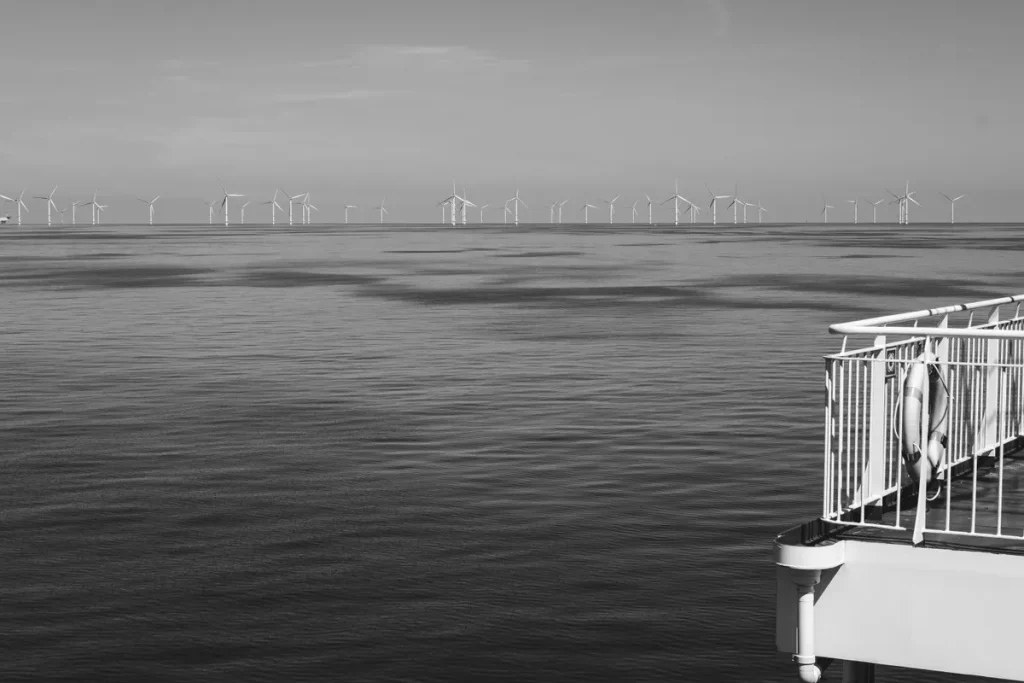

The RWE offshore wind settlement announced on 6 August tells you everything about how the Trump administration has chosen to prosecute its energy policy: not through courts, which repeatedly blocked executive action, but through the cheque book. The German energy group will receive $1.22 billion from the Department of the Interior (DoI) in exchange for handing back its offshore wind leases off California, Louisiana, and in the New York Bight.
RWE had previously sunk more than $1 billion into acquiring those leases and developing the associated projects. The relinquished sites could have generated roughly 7 gigawatts of power, enough to supply more than 5 million homes. The company now holds no remaining U.S. offshore wind leases.
What RWE Gets, and What It Does With the Money
The settlement is not a penalty, nor is it a fine. It functions, in substance, as a buyout. RWE plans to redirect the proceeds into conventional energy: $900 million will go towards acquiring an indirect 16% stake in the Louisiana LNG Project, a large-scale natural gas export terminal under construction in Louisiana. A further $300 million will be spent on natural gas turbines, with 15 natural gas projects under development across the United States.
RWE Americas currently operates approximately 13 GW of generation capacity across 27 U.S. states. The company says it intends to grow that figure to 22 GW by 2031, having commissioned 2 GW of new capacity in 2025 alone. Taken together with the broader €17 billion ($19.6 billion) planned investment in U.S. generation over the next six years, the firm is not retreating from America; it is repositioning inside it.
‘After careful consideration, it was determined there is no path forward to permit these projects in the US for the foreseeable future,’ RWE said in a statement. That is a polite way of acknowledging something the administration’s own legal record had already confirmed.
The RWE Offshore Wind Settlement Is the Fifth of Its Kind
This deal did not emerge from a position of strength for the White House. Federal courts had repeatedly thwarted the administration’s attempts to halt offshore wind development through executive order, according to the 1012 Industry Report. Voluntary lease relinquishments, structured as settlements, were the workaround.
The approach has now been applied five times. In March 2026, TotalEnergies received nearly $1 billion, essentially a refund of its two offshore wind lease costs, contingent on redirecting the money to fossil fuel projects including a Texas LNG plant and conventional oil development in the Gulf of Mexico. In April, the DoI struck a deal with Golden State Wind and Bluepoint Wind, led by Ocean Winds, paying out $885 million in exchange for the voluntary termination of their leases. In June, Invenergy agreed to relinquish four offshore wind leases for $765 million, according to Offshore Wind Biz.
Last month brought the Duke Energy settlement. Duke’s Carolina Long Bay lease, purchased in 2022 for $155 million and expected to generate 1.3 GW of power for roughly 300,000 homes, was surrendered in exchange for $129 million, a partial reimbursement, according to WECT News. (The original wire report cited $129 billion for the Duke settlement; findings from Utility Dive and Offshore Wind Biz confirm the correct figure is $129 million.) Duke’s Kodwo Ghartey-Tagoe, executive vice president and chief executive of Duke Energy Carolinas, said the company would ‘refocus’ the money into ‘additional generating capacity, which may include advancing new nuclear and natural gas generation, and grid enhancements to strengthen reliability, support continued growth in the Carolinas and keep costs as low as possible.’
Add it up and the Trump administration has now paid out nearly $4 billion across these five agreements to clear the offshore wind sector from American waters. Interior Secretary Doug Burgum framed the RWE deal in terms of energy security: ‘We welcome RWE’s agreement and voluntary investment in projects that strengthen our nation’s energy security.’ The word ‘voluntary’ is doing considerable heavy lifting there.
My read is that this is a policy in which the administration has discovered it cannot ban its way to a fossil-fuel renaissance, so it is buying its way there instead. The question is whether Congress, at some point, notices that ‘drill, baby, drill’ has an invoice attached to it. The next offshore wind lease holder to receive a cheque will be the answer to how long that scrutiny can be deferred.
