


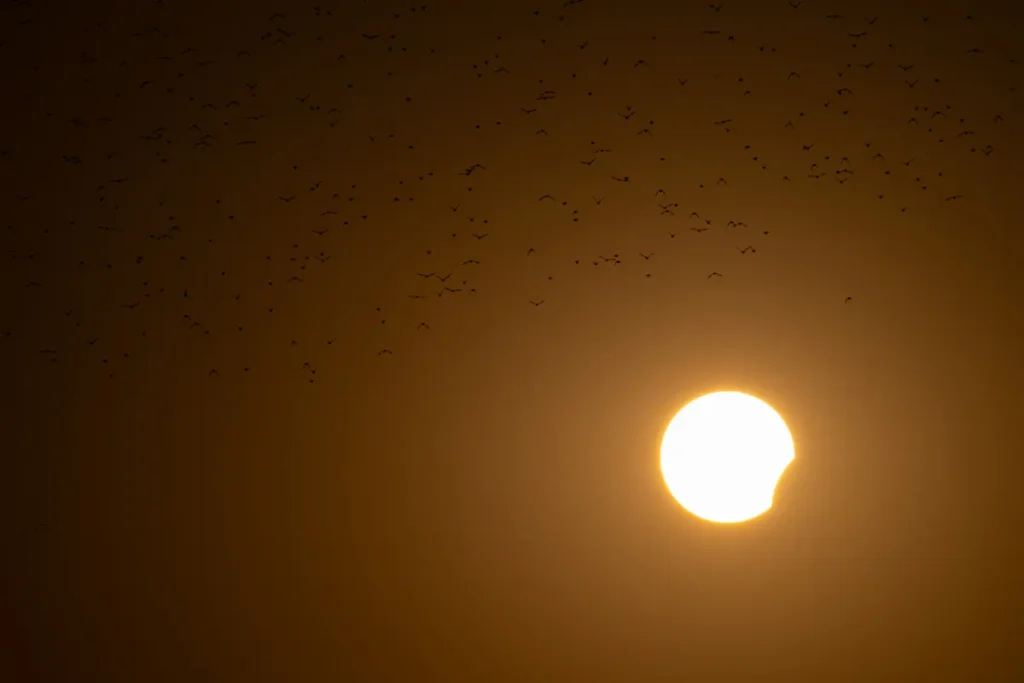

With Wednesday’s partial solar eclipse less than a day away, the UK Health Security Agency (UKHSA) is still urging people to seek out certified solar eclipse glasses, even as stocks across the country have effectively collapsed. Bakeries, corner shops, and WhatsApp channels are now filling the gap that major retailers and online marketplaces cannot.
The eclipse on 12 August 2026 will obscure roughly 90% of the Sun, making it the most significant the UK has experienced since 1999. The demand that has followed has been, by any measure, extraordinary.
A staff member at one central London bakery told the BBC they had sold around 100 pairs on Monday morning alone. Royal Museums Greenwich, explicitly recommended by the UKHSA as a reputable source, has sold out entirely, citing an ‘unprecedented volume’ of orders. Pairs still available online either require expensive next-day delivery or will simply not arrive in time.
Finding Solar Eclipse Glasses in Time
The improvised supply chain now doing the work is genuinely odd. A WhatsApp channel advertising stock in corner shops has attracted thousands of followers in a matter of days. Reddit and Facebook threads are directing buyers to online marketplaces, some offering bulk purchases at a premium. One buyer told BBC Radio 4’s PM programme that she had specifically searched for a way to collect glasses in person, having already concluded she had left it too late for delivery.
The UKHSA’s advice is plain: be cautious of anything sold online if you cannot verify its certification. UKEclipse, an initiative run by UK astronomers, adds that major eclipses reliably attract counterfeit and substandard products. The American Astronomical Society (AAS) publishes a list of manufacturers whose glasses have been independently lab-tested, which is the most reliable shortcut available at this point.
If you have managed to get hold of a pair, test them before Wednesday. Indoors and outdoors, you should be able to see nothing except very bright light sources. Outside, glancing at the Sun for under a second should reveal only, in the AAS’s words, ‘a sharp-edged, round disk… that’s comfortably bright, with a dark background all around it.’ If the image is anything other than that, the glasses are not safe.
What ISO 12312-2 Actually Means for Your Eyes
The ISO 12312-2 standard that the UKHSA requires is not a marketing label. Glasses meeting that specification block 100% of harmful ultraviolet and infrared radiation and reduce visible light transmission to well under 0.001%, according to safety documentation published by Helioclipse. Regular sunglasses do not come remotely close to that. Planetarium astronomer Imo Bell of The Royal Observatory Greenwich put it directly to the PA news agency: specialist eclipse glasses are ‘very, very different’ to ordinary sunglasses and will not offer protection. Worse, the UKHSA notes that sunglasses can reduce glare and make prolonged staring more comfortable, which means they can actually increase the damage done.
For those with nothing, a pinhole projector remains the only safe option. A single piece of card works. So does a colander, which projects multiple images simultaneously. It is indirect, but it is not nothing.
The stakes here are real. The Royal College of Ophthalmologists recorded around 70 cases of vision problems following the 1999 eclipse. Around 40% of those affected had looked at the Sun for less than a minute. The college’s president, Mohamed Elalfy, has explained why people tend to underestimate the risk: ‘Crucially, the retina has no pain receptors, so people will not feel the damage as it happens.’
If you are still searching for certified glasses and cannot find them locally, Forbes has documented manufacturers whose products meet the standard, including American Paper Optics, which supplied eclipse glasses to NASA’s Artemis II crew during its mission around the Moon in April 2026, and Germany’s Baader Planetarium, which supplies through European retailers. The European Space Agency has also published guidance from ESA reserve astronaut Sara García Alonso, explaining precisely why certified lenses are not interchangeable with anything else you might have at home.
One alternative, if you genuinely cannot find eclipse glasses: Popular Mechanics notes that welding glasses rated at shade 12 or higher are safe for solar viewing, with shade 14 offering the highest level of protection. Welding suppliers are rather less picked-over than bakeries right now.
My read is that the scramble itself tells you something. The UK does not get eclipses like this often, and Wednesday’s will not be bettered for a very long time. That is worth doing properly. Anyone who experiences a change in vision after looking at the Sun should contact an eye-care professional immediately.
