


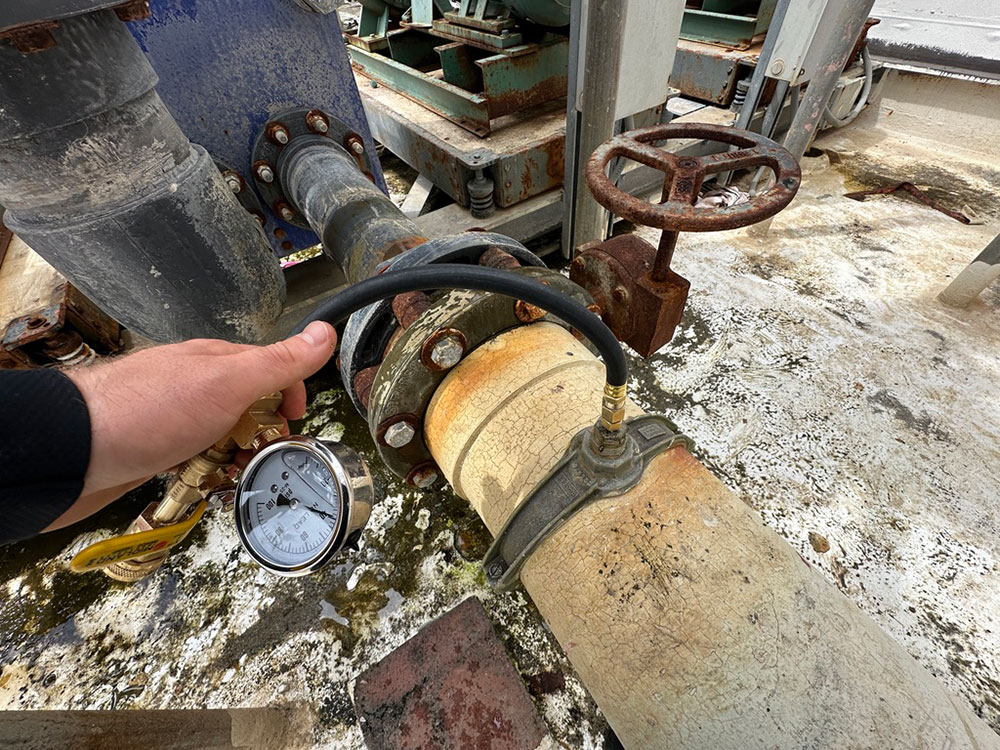

Professional water testing for cooling towers, closed-loop HVAC systems, and Legionella-related risk evaluation throughout coastal Palm Beach County.
When people think about water testing, they usually think about drinking water. But in large buildings throughout South Florida, some of the most important water to monitor is the water hidden inside cooling towers, condenser loops, and closed-loop water source heat pump systems.
These systems are essential to how many commercial buildings, condominiums, hotels, and high-end properties operate. When the water inside them falls out of balance, the result is not always obvious at first. Problems often begin quietly — internal corrosion, mineral scale, biological growth, declining efficiency, shortened equipment life, and in some cases, potential Legionella risk.
That is why water testing in these systems is not just a maintenance item. It is a form of risk management.
At Full Spectrum Environmental, we provide water testing and system evaluation services throughout West Palm Beach, North Palm Beach, Palm Beach Island, South Palm Beach, Delray Beach, Highland Beach, and surrounding coastal communities, helping clients better understand the condition of their mechanical water systems and whether the treatment program is truly working.
In South Florida, these issues can be amplified by climate, building age, system complexity, and the realities of coastal construction. Warm temperatures, year-round HVAC demand, salt air, humidity, and older infrastructure can all create conditions where water quality problems become expensive fast. What may begin as a chemistry imbalance can eventually turn into leaks, fouled heat exchangers, damaged pumps, tenant complaints, or major maintenance costs.
One of the most important concerns in open systems such as cooling towers is Legionella. This bacterium can become a serious issue when water conditions allow amplification within a building water system. Cooling towers are especially important to monitor because they combine warm water, air movement, and the potential for biofilm and stagnation if treatment is not properly controlled. For building owners and managers, routine testing can play an important role in verifying conditions, documenting due diligence, and identifying whether corrective action may be needed.
But biological risk is only part of the story.
In closed-loop water source heat pump systems, chemistry control is often just as important as microbiological control. These loops are designed to operate as controlled internal environments, but when water quality is neglected, the loop can begin to attack the very components it is supposed to support. One of the most common issues involves the presence of dissimilar metals within the same system. When different metals are connected through water that is not chemically stable, galvanic corrosion can occur. Over time, that can contribute to internal metal loss, sediment buildup, flow restrictions, and premature failure of system components.
This is where water testing becomes highly valuable. Instead of guessing, owners and engineers can look at the chemistry directly.
Parameters such as pH, residual chlorine, and corrosion inhibitor levels help show whether the water is stable or whether it may be promoting corrosion, scale formation, or biological growth. If pH drifts too far in either direction, metal surfaces may become more vulnerable. If disinfectant residual is not where it should be, microbial control may be insufficient. If inhibitor levels are low or inconsistent, the loop may not have adequate protection against internal corrosion. In many buildings, these issues are not discovered until staining, debris, pressure issues, or equipment problems begin to show up downstream.
Testing also helps answer a basic but important question: Is the treatment program actually performing the way everyone assumes it is?
That question matters in luxury coastal properties, commercial facilities, and multi-family buildings alike. It is easy to assume that because a system is operating, the water inside it must be acceptable. In reality, a system can keep running while internal conditions steadily deteriorate. By the time a major issue is visible, the damage may already be well underway.
At Full Spectrum Environmental, our work is focused on giving clients meaningful information they can use. We evaluate cooling tower water and HVAC loop water from an environmental and building-performance perspective, helping owners, managers, engineers, and facilities teams identify concerns related to Legionella, corrosion potential, water balance, treatment effectiveness, and overall system condition. Our role is to provide clear testing, professional interpretation, and practical insight into what the water may be doing inside the system.
For properties throughout Palm Beach County’s coastal corridor, this kind of testing is particularly relevant. Buildings in West Palm Beach, Palm Beach Island, Highland Beach, Delray Beach, North Palm Beach, and South Palm Beach often contain complex mechanical infrastructure that must operate reliably in a harsh environmental setting. Routine water quality evaluation can help protect that investment.
When properly performed, water testing is more than a box to check. It is a way to catch issues early, support preventative maintenance, reduce avoidable damage, and better understand whether the system is being protected from the inside out.
If a building relies on a cooling tower, condenser loop, or water source heat pump system, understanding the water chemistry inside that system is not optional forever. At some point, it becomes the difference between proactive control and reactive repair.