


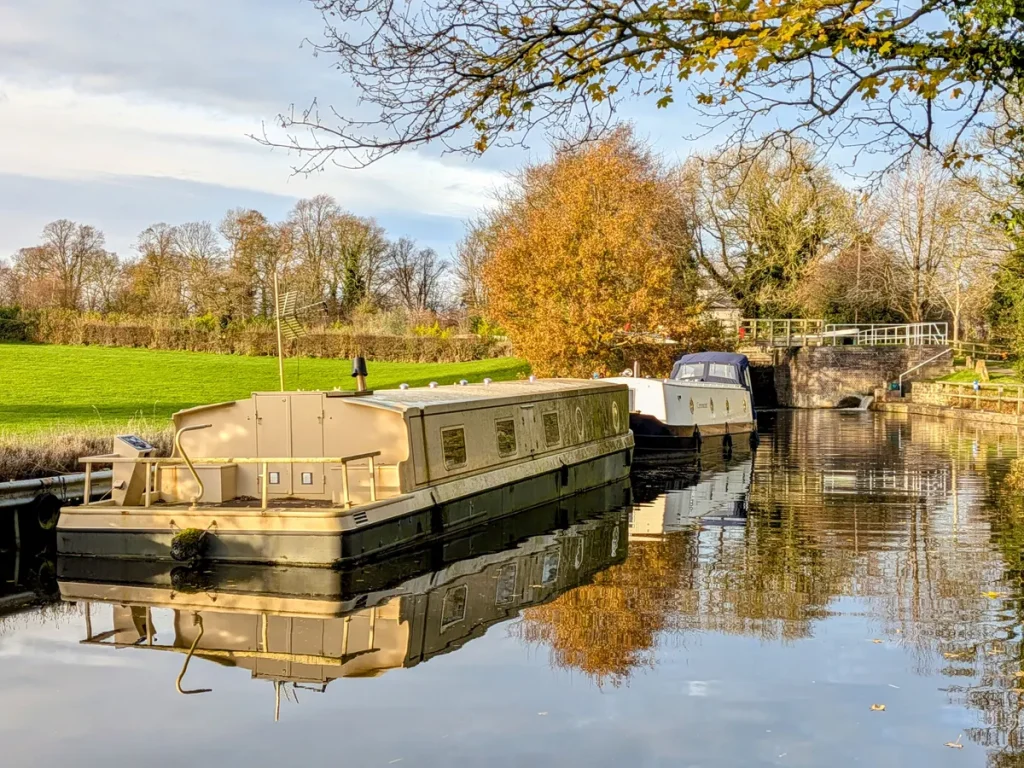

Narrowboat living costs are drawing in a new wave of homeowners fleeing mortgages, but the people who have actually made the move tell a more complicated story than the brochure version.
Ken Tracey, 57, sold his house in Suffolk in 2022. The payments had become unmanageable. ‘The cost of the house, it was really tricky to keep up with everything, keep the payments going,’ he says. He spent £75,000 on his narrowboat, then a further £20,000 on unforeseen maintenance he had not budgeted for. The mortgage is gone. The outgoings are not.
His verdict is still broadly positive (‘I like being here, it’s genuinely amazing’) but he is candid about the learning curve. It took him more than 18 months to get to grips with steering. Locks, he warns, are dangerous. The technology underpinning canal infrastructure is, in his words, ‘a couple of hundred years old.’ None of that is in the sales pitch.
The Numbers Behind Narrowboat Living Costs
The appeal is real. According to the Canal & River Trust’s Annual Boaters’ Survey 2026, in Yorkshire and the North East, 34% of respondents said they used their boat as a permanent home in 2026, up from 27% in 2025. A further 49% described it as a temporary home. The drift towards full-time living afloat is not anecdotal.
Yet the same survey found that overall boater satisfaction has slipped to 50% in 2026, down from 55% in 2025, though still above the 2024 low of 46%. More damaging is this: 70% of boaters said they were unable to navigate as expected in 2026, a figure that points to genuine infrastructure strain rather than individual inexperience.
The Canal & River Trust has responded with a Better Boating Plan backed by £3 million of targeted investment, and its dredging programme removed over 60,000 tonnes of material, improving more than 40 miles of waterway in 2024/25. Whether that is enough, across 2,000 miles of waterways in England and Wales, is a fair question.
Who Is Actually Moving Aboard?
The profile of residential boaters is worth understanding before romanticising the decision. A Canal & River Trust Boat Owners Survey found that 48% of residential boaters are under 55, compared with 28% of other boaters. Income tells an equally pointed story: 48% of those living aboard earn less than £20,000 per year, against 20% of other boaters. This is not principally a retirement lifestyle. It is, in many cases, a housing-affordability response.
The Canal & River Trust’s 2024 Boater Census Survey, which drew nearly 9,500 responses (just under a third of all current boat licence holders) found that liveaboard boaters face particular challenges accessing financial services, medical support, and benefits. A fixed address is, it turns out, load-bearing infrastructure in British civic life.
Andy Brown, who had a narrowboat built after retiring with his wife and moving off from Edinburgh, says the reality is that costs are ‘probably a bit cheaper than living in a house, but not significantly so.’ That squares with the data. The purchase price and maintenance expenditure are visible; the access difficulties are not.
Ken Marshall, from Wakefield, has lived aboard his boat Willow full time for two years. He says the community aspect surprised him. ‘I find in general that people are very open to talking and helping,’ he says, moored at Granary Wharf in Leeds city centre. His primary logistical concern each time he moves is ensuring he can reach work. Narrowboat life, at that level, is a logistics operation as much as a lifestyle.
Eric Wilson, just over a month into life on the water after cashing in his pension to fund the move, has found it harder than expected. He had planned to travel the canal network. The locks, he admits, are proving too physically demanding. ‘I was expecting to go off and travel the canal network, but I tried doing a couple of locks and it’s too hard for me now,’ he says. ‘I think you’ve got to be fit, really.’
Alex Hennessy, the national boating manager at the Canal & River Trust, is direct about his advice for anyone tempted: try a hire boat first. Build the experience before selling the house.
My read is that narrowboat living is a legitimate alternative for the right person, in the right physical condition, with realistic expectations about cost and complexity. But for a growing share of those choosing it, the driver is not wanderlust. It is that housing has become unaffordable and the water is what remains. That is not a lifestyle trend. It is a housing-policy failure dressed in waterproofs. The 2027 survey will tell us whether the numbers keep rising.
