


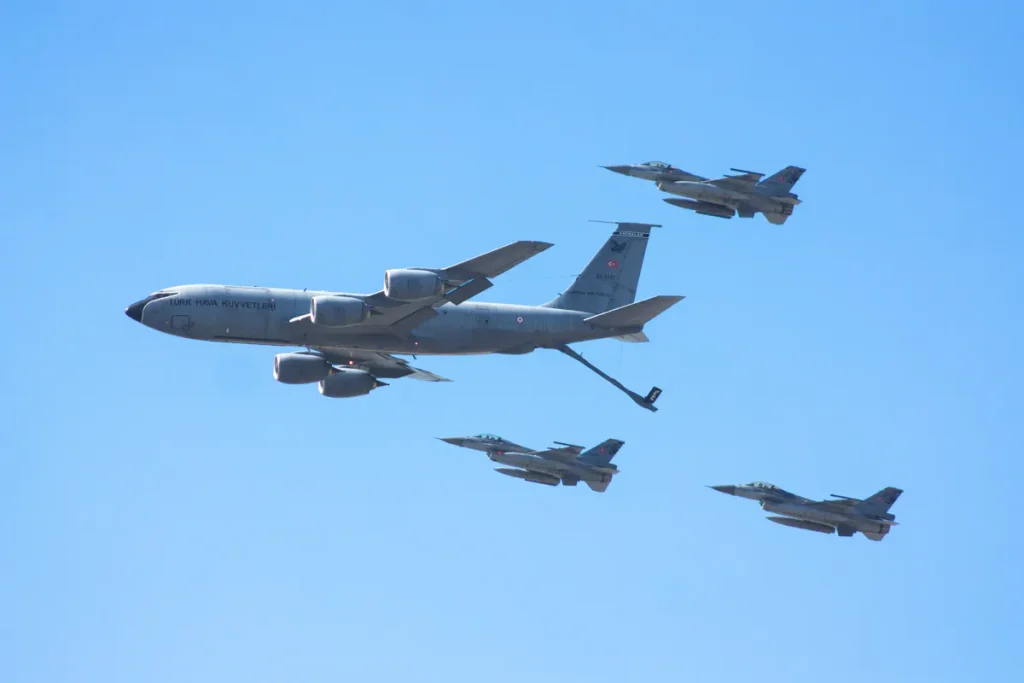

The full scale of Christopher Harborne’s military interests, spanning Pentagon jet fuel contracts, autonomous weapons development, and commercial ties with Thai armed forces, sits at the heart of a conflict-of-interest question that Reform UK has so far refused to take seriously.
Harborne has made 31 individual donations totalling £26,817,500, with £25,190,000 going to Reform UK, according to donation tracking data. That figure does not include the £5m gift to Nigel Farage personally, which the MPs’ standards watchdog is investigating. The party’s own manifesto commits Reform to increasing defence spending, creating tax breaks for the UK defence industry, and setting up a procurement body to sharpen equipment acquisition. It is a policy platform that reads, at points, like a brief written for a man who holds a 15% stake in QinetiQ and whose company supplies the US military in 62 locations worldwide.
The Pentagon Pipeline
AML Global, Harborne’s jet fuel brokerage, began life supplying civilian aircraft. Pentagon contracts followed from 2013, starting modestly (a $4,000 shipment to the Philippines) before surging late in Donald Trump’s first presidential term. Total US military contracts now exceed $140m, according to published US government procurement data.
Publicity material from AML Global’s Northern Irish partner, Jet Assist, claims no other company supplies the US military with jet fuel in more countries beyond American borders. The locations include Europe’s frontier with Russia, the Middle East, a South Pacific outpost, and Asian allies facing Chinese pressure. That geographic reach means Harborne is not merely a peripheral fuel supplier; he is trusted by the Pentagon in strategically sensitive locations.
‘The government vets these companies,’ said Jerry McGinn, a military procurement expert at the Center for Strategic and International Studies in Washington. ‘They take this very seriously.’
The recruitment of US military personnel into AML Global has been deliberate. Scott Elder, the company’s vice-president, is a former colonel in the US air force who previously served as a Pentagon liaison at the US embassy in Bangkok. He joined AML Global shortly after leaving government service.
Harborne Military Interests Inside the UK’s Defence Establishment
QinetiQ Group PLC, incorporated in November 2002 following the privatisation of the Ministry of Defence’s research arm under Tony Blair, is where Harborne’s position inside British defence is most exposed to scrutiny. He is the company’s largest shareholder, with a stake worth roughly £400m. QinetiQ operates Hebridean missile-launch sites, maintains Royal Air Force Typhoon fighter jets, develops stealth capabilities for nuclear submarines, and builds the drones and autonomous systems redefining modern warfare.
Harborne began building his QinetiQ stake in 2022, the same year he was also donating to Boris Johnson’s Conservatives. He has since expanded his military tech portfolio further: in March he acquired a stake in a company developing powered exoskeletons for infantry, and earlier purchased shares in a low-earth-orbit satellite venture that competes with Elon Musk’s Starlink.
Transparency International UK noted, as of 5 March 2026, that Harborne had by then given Reform £15,450,561, making him the party’s largest single financial backer by a significant margin.
Donations and Reform’s Defence Policy
The BBC reported that Harborne’s £9m donation in August 2025 was the largest single sum ever given by a living person to a British political party. A further £3m followed in early 2026. Across his political giving history, Channel 4 News reports Harborne also donated approximately £1.79m to the Conservative Party and £10.2m to the Brexit Party before his focus shifted decisively to Reform.
Reform denies any conflict of interest. A party spokesperson said Harborne had not discussed defence spending, defence policy or foreign policy with Farage or party officials. Harborne’s lawyers at Schillings say he ‘has not sought to influence any politician to support any of his commercial business interests.’
Farage has been less guarded in his admiration. ‘Christopher Harborne is an immensely successful man,’ he told the Triggernometry podcast in July. ‘They all say crypto, but actually that is but a part of what this guy does. I think there are some things that are known in public, such as his big stake that he holds in QinetiQ, the defence technology company. I think he probably owns the biggest jet refuelling operation in the world, plus his crypto investments.’
Sam Power, a political funding expert at the University of Bristol, framed the risk with care: ‘It doesn’t necessarily follow that Reform will have policies that will benefit Harborne’s interests in the military-industrial complex. But it warrants a spotlight. It will be interesting if Reform’s policies start aligning with Christopher Harborne in this area as they have in cryptocurrency.’
Reform’s manifesto already points in that direction. Whether the policy and the donor’s portfolio continue to converge is the question that the next electoral commission reporting period may not answer, but the defence spending debates of the next parliamentary session almost certainly will.
