


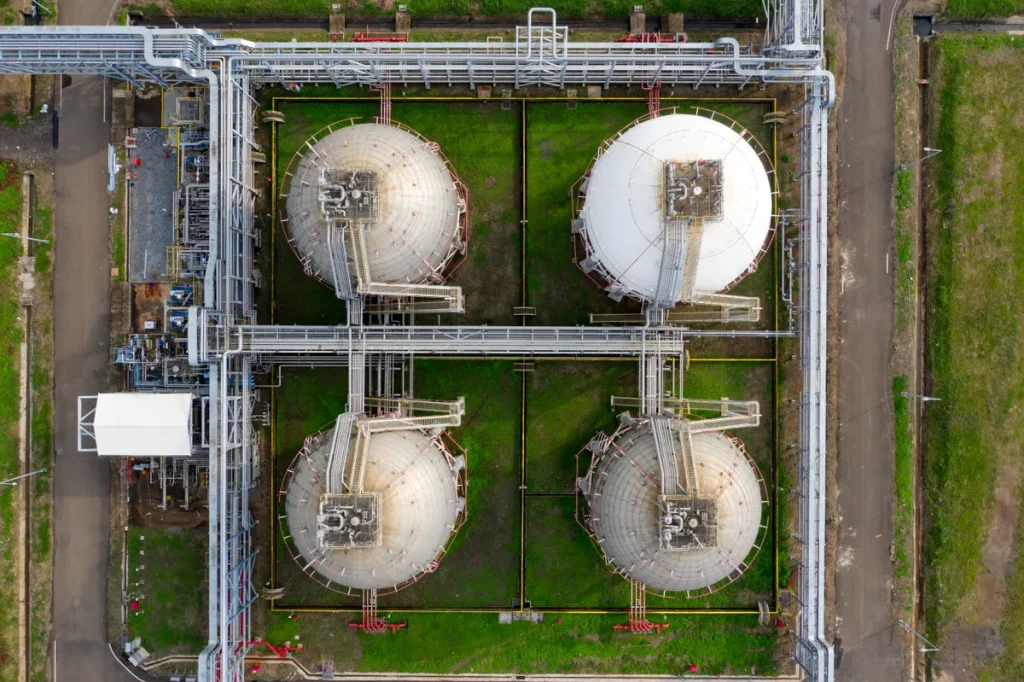

EU gas storage levels have dropped to their lowest point in 13 years, and Britain, with its threadbare domestic reserves and near-total dependence on imports, is among the countries with the most to lose this winter.
According to data from Gas Infrastructure Europe (GIE), EU storage facilities were 63% full in the final week of August, well below the 80% average for that point in the year. As of 19 August, the figure stood at 61%, against 76% in mid-August 2022, 90% in 2023, and 89% in 2024. Greg Molnar, a gas analyst and professor, estimates the bloc will enter the winter heating season with stocks roughly a fifth below the five-year average.
‘Low storage levels are naturally increasing the risk of heightened winter price volatility,’ Molnar said, warning that cold spells or slow wind patterns could accelerate gas usage and compound the problem.
Bjarne Schieldrop, chief analyst commodities at Nordic banking group SEB, is blunter. Europe’s gas market had ‘stayed relatively calm’ this summer in the hope that the Strait of Hormuz would reopen. When that expectation collapsed, so did the calm. ‘As a result, the European natural gas market has run into a bit of a winter panic over the past week,’ Schieldrop said.
Benchmark Dutch TTF gas prices have climbed to above €68 per megawatt-hour, a three-year high and more than double the price at the start of the year. Analysts at Goldman Sachs have warned that, without a restoration of Middle East gas exports, European prices ‘would likely need to move above €100/MWh’ to attract sufficient liquefied natural gas cargoes to meet winter demand. Goldman’s own scenario modelling, published on the Goldman Sachs insights page, put the figure more precisely: a one-month full halt to Hormuz LNG flows would push TTF towards €74/MWh; a disruption lasting more than two months would likely lift prices above €100/MWh. The Strait carries approximately 80 million tonnes per annum of LNG, representing 19% of global supply, according to Goldman Sachs Research. A Bloomberg report on the Goldman note confirmed the bank sees even the current rally as insufficient to divert enough LNG from Asia if disruptions extend into next year.
Why EU Gas Storage Levels Matter More for Britain Than Brussels
The disparity within Europe is stark. Italy’s storage stands at 84.19% full; Poland’s at 97.32%, according to the GIE live dashboard. Germany’s facilities, Europe’s largest by capacity, are roughly half-full. Belgium and the Netherlands, which connect directly to Britain’s gas network via pipeline, sit at 51% and 45% respectively.
The UK’s own position is worse still. GIE dashboard data puts GB storage at just 31.31% full, a figure that reflects a chronic structural weakness rather than a seasonal quirk. The UK’s total gas storage capacity amounts to around 10% or less of that held by France, Germany, or the Netherlands, according to Centrica’s own analysis.
Chris O’Shea, chief executive of British Gas owner Centrica, said this week the UK had ‘almost no gas in storage’ for the coming winter. The country relies on pipeline imports from continental Europe and LNG tankers from the US and the Middle East, giving it little buffer if either route tightens.
Centrica’s Rough facility, located 18 miles off the Yorkshire coast, accounts for more than half of the UK’s entire storage capacity: 54 billion cubic feet (bcf), enough to heat approximately 2.4 million homes through a winter. Centrica has said it could invest £2 billion to upgrade Rough to maximum capacity, but is seeking government backing through a price cap and floor mechanism to make that viable, as set out on the Centrica website.
No Mandatory Target, No Safety Net
Part of what makes Britain’s position structurally precarious is the absence of any legal obligation to hold minimum reserves. The EU introduced mandatory storage targets after Russia’s invasion of Ukraine sent prices soaring. The UK never followed suit.
Ofgem has already confirmed that typical household gas and electricity bills will rise 4% from October, following a 13% increase in July, both driven by global market pressure from the Iran conflict. That is the cost to consumers of an infrastructure gap that policymakers have been slow to close.
The longer-term picture is no more reassuring. North Sea production is declining, and Norwegian output is expected to begin falling from 2030. If Hormuz remains constrained into late autumn, the €100/MWh threshold Goldman Sachs identified is not a worst case. It is a realistic mid-case. Britain, with its minimal storage buffer and mandatory-target vacuum, would feel that most acutely of all.
