


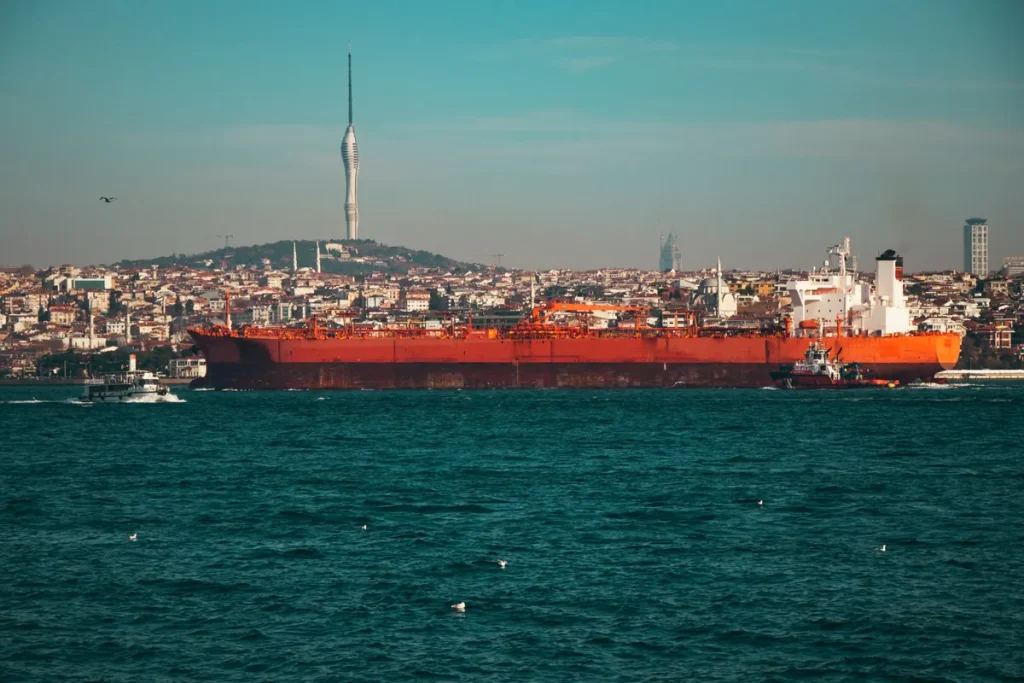

Strait of Hormuz oil prices dropped sharply on Tuesday as senior US officials signalled that a deal to reopen the waterway to commercial shipping could be days away, sending Brent crude down by almost 5% to under $80 a barrel and US West Texas Intermediate down more than 5% to $76.
Both contracts fell to their lowest levels since 13 July, a move that reflects how much of the recent risk premium rests on one question: whether ships can transit the strait freely again.
What Washington Is Saying About the Strait of Hormuz
Secretary of State Marco Rubio confirmed progress in discussions involving Iran and Oman. ‘There’s been progress made in those talks, but not finality yet. We’re hoping that will happen very shortly,’ he told reporters at the State Department.
Treasury Secretary Scott Bessent went further. There was a ‘chance we may have a deal today or tomorrow to open the strait and move towards a more normalized position in this conflict,’ he told CNBC. On whether Iran would be permitted to charge for passage, Bessent said, ‘It would be freedom of movement.’
That is a meaningful concession to parse. Free passage, with no Iranian toll, is the version the market most wants. Whether Tehran agrees is another matter entirely.
Iran has stated plainly that it is not negotiating with the United States and has no plans to do so. It is instead talking to Oman, which is acting as a mediator. An Iranian foreign ministry spokesman said those discussions had been ‘positive’. Qatar, meanwhile, confirmed it was continuing efforts with other mediators but acknowledged no direct US-Iran talks were currently planned.
The Price Context: From $128 to Near $80
The scale of the price swing over this conflict is worth holding in mind. According to Anadolu Agency, citing the US Energy Information Administration (EIA), Brent averaged $103 a barrel in March 2026, up $32 from February, with daily prices climbing to nearly $128 on 2 April. Tuesday’s sub-$80 print is, by that measure, a substantial retreat.
The EIA’s July 2026 Short-Term Energy Outlook now forecasts Brent averaging $82 a barrel for the full year 2026 and dropping to $65 in 2027, projections built on an assumption that Hormuz flows normalise. If they do not, the picture is very different. Investing.com, citing Goldman Sachs analysis, puts the bank’s base case at $85 for 2026 Brent, with upside above $120 if Hormuz remains severely restricted through the third quarter. The strait handled roughly one-fifth of global daily oil and liquefied natural gas supplies before the conflict began in late February.
Danni Hewson, head of financial analysis at AJ Bell, captured the market’s wariness well. ‘Investors are acutely aware of how many times we’ve already been at this point in the war and how fragile the process of securing lasting agreements can be,’ she said. That caution is rational: previous rounds of talks have produced optimism and then disappointment in roughly equal measure.
At the pumps, the damage is visible. In the UK, the RAC, via the BBC, puts the current petrol average at around 158p a litre, up from 133p before the war started. Diesel has risen from 142p to 192p over the same period. In the United States, AAA recorded a national average of $4.0121 per gallon for regular gasoline as of 9 August 2026. Diesel stood at $5.3082 per gallon, slightly below the snippet’s ‘almost $5.40’ figure; the AAA primary data is used here. EIA monthly retail data shows both fuels have been falling since May 2026 peaks of $4.609 and $5.600 per gallon respectively, which suggests some relief was already coming before Tuesday’s news.
The elevated prices have delivered bumper profits to BP, Shell, Chevron and Exxon Mobil. Hewson noted, however, that those revenues leave the companies ‘at the mercy’ of US President Donald Trump’s ‘machinations’. On Monday, Trump warned Iran it faced its ‘last chance’ to agree a deal, adding that he had called off ‘massive’ strikes to allow talks to continue.
My read is that the market is right to price in some probability of a deal while refusing to go all-in. The Iran-Oman channel is real and has produced results before. But the gap between Washington’s version of events and Tehran’s remains wide, and that gap has a habit of snapping shut any rally built on optimism alone. Watch for a formal Omani statement: that is the signal the market is actually waiting for.
