


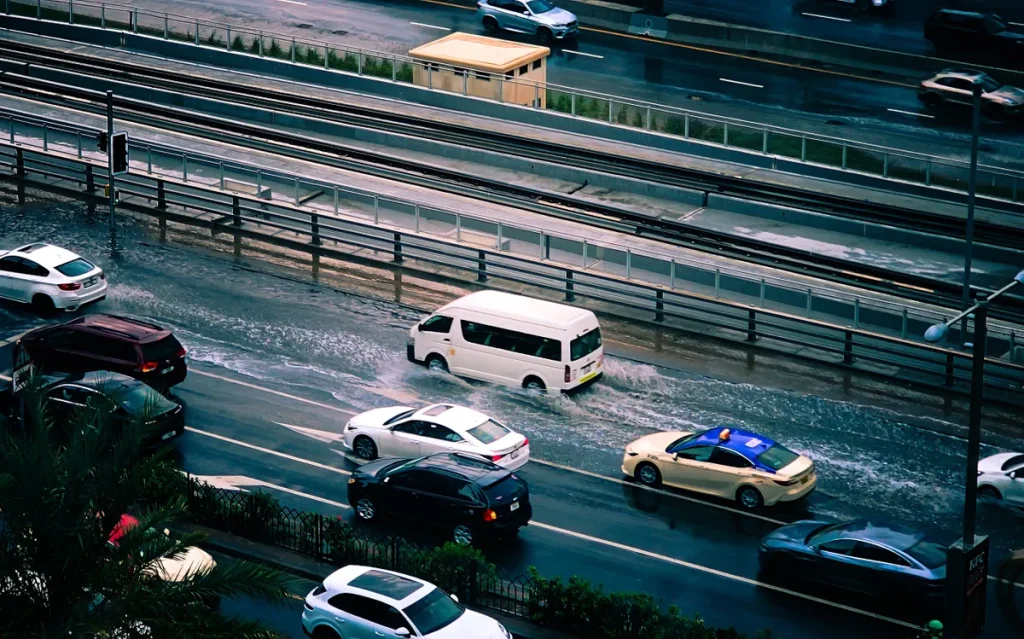

A Heathrow pipe burst flooding incident shut road access to Terminals 2 and 3 in the early hours of the morning, leaving passengers stranded during one of the airport’s busiest stretches of the year. Roads were sealed just before 06:00 BST, with the airport warning that anyone trying to reach either terminal by car faced an impossible journey.
The burst pipe sits beneath Inner Ring Road West, which runs through the central terminal area (CTA), a zone that encompasses Terminals 2 and 3, the Heathrow Central bus station, and a cluster of office and service buildings, according to Simple Flying. Water pooling across that road network made vehicular access to the CTA impossible. Access to the terminal car parks was also blocked, trapping vehicles already on site.
The pipes are owned by Heathrow Airport itself, which took responsibility for the repairs. An airport spokesperson said: ‘Our teams are working to resolve the situation as quickly as possible. We apologise for any disruption caused. The leak has been isolated and repairs are ongoing.’
US Carrier Passengers Among Those Hit by Heathrow Pipe Burst Flooding
The timing was painful for a specific group of travellers. Terminals 2 and 3 are home to the majority of the airport’s US carrier operations, with United Airlines, American Airlines, and Delta Air Lines all operating from those stands. For transatlantic passengers already managing long-haul logistics, a road closure at dawn is not a minor inconvenience.
One human cost came quickly. George Smyrniadis, 79, missed his flight to Frankfurt, where he was travelling for a school reunion, as a direct result of the disruption, BBC News reported.
For those who still needed to travel by car, the airport advised using Park and Ride, then transferring to Terminals 4 or 5, and from there taking free rail services (the Heathrow Express, the Elizabeth Line, or the Piccadilly Line) to reach Terminals 2 or 3, according to The Independent. The airport also fielded queries on X, at one point directing a passenger collecting a wheelchair user from Terminal 3 to park at Terminal 4 or 5 and transfer, assuring them that assistance teams were in the terminal to help navigate the return journey.
All roads subsequently reopened, with the airport confirming it was operating as normal. Passengers were still advised to use public transport where possible because of heavy congestion on the surrounding road network even after the closures lifted.
A Second Infrastructure Headache in Days
The flooding was not the first infrastructure failure to hit Heathrow in quick succession. Days earlier, a water leak forced the closure of a tunnel, producing what Network Rail described as ‘major disruption’ as Elizabeth Line services between Hayes and Harlington and Heathrow Terminals 4 and 5 were suspended for an entire morning. That left passengers who might otherwise have taken the train with fewer options, and it makes the advice to use public transport feel faintly ironic given the week Heathrow has had.
The consumer rights group Which? urged passengers to check airline policies before assuming they had no recourse. The editor of Which? Travel, Rory Boland, said: ‘Passengers heading to Heathrow today will understandably be worried, so it’s important to follow the airport’s advice and avoid travelling by road to Terminals 2 and 3, instead allowing extra time and using public transport where possible.’
Boland also advised those worried about missing flights to contact their airline immediately, noting that policies on missed flights vary and that passengers may be entitled to free rebooking or refunds. He recommended checking travel insurance for coverage of additional costs, and contacting parking providers to amend or refund bookings made unusable by the road closures.
The disruption fell during the school holidays, which Heathrow has noted is its peak period. The airport recorded its busiest day of the year on 19 July, with more than 267,000 passengers passing through as schools broke up for summer. Heathrow handled 84.46 million passengers across 2025 as a whole, a new all-time record for the airport, according to Road Genius, which also ranks it as the world’s most internationally connected airport, serving 214 destinations. On a normal day, the airport processes up to 1,300 flight movements.
The airport now faces questions about the resilience of ageing infrastructure at a site handling volumes it was never originally designed for. A single burst pipe beneath a road should not be capable of paralysing a terminal cluster. Whether Heathrow’s investment programme addresses that vulnerability is the question worth asking before the next school holiday rolls around.
