


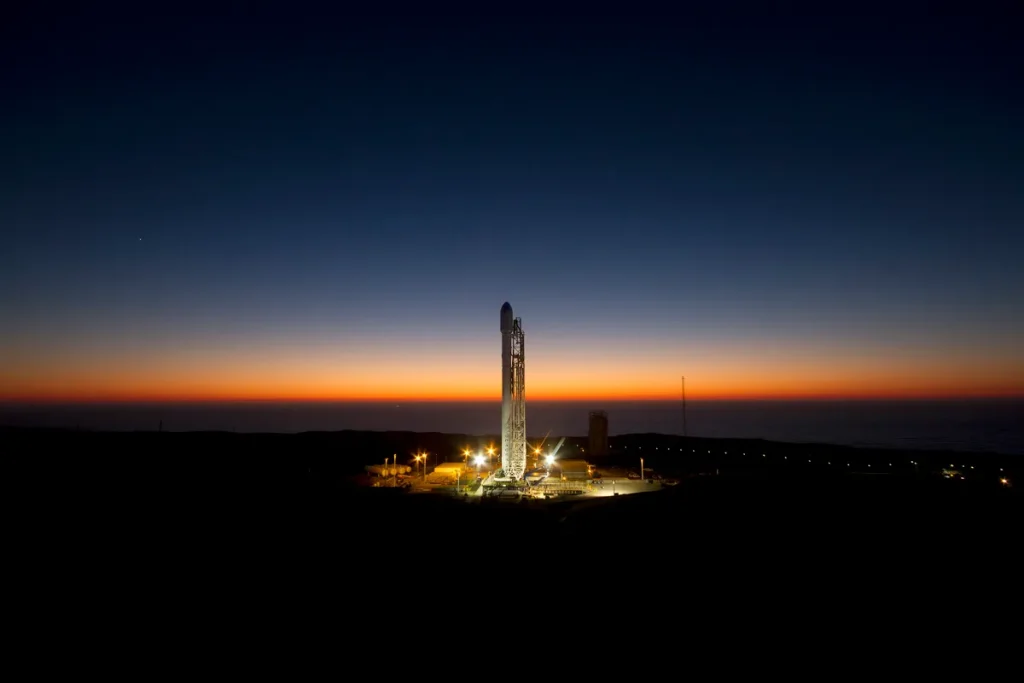

The SpaceX IPO valuation debate has arrived at the moment of truth, as Elon Musk’s rocket and satellite company begins trading on the Nasdaq today under the ticker SPCX after raising $75 billion in what is, by some distance, the largest initial public offering in history.
The base deal, priced at $135 per share for 555,555,555 shares of Class A common stock, values SpaceX at $1.77 trillion, according to SpaceX’s S-1 filing with the SEC. Underwriters led by Goldman Sachs and Morgan Stanley also hold an over-allotment option to buy an additional 83.3 million shares at the same price for up to 30 days, which would generate a further $11.25 billion and lift the total aggregate raise to roughly $86 billion.
To put the scale in context: the base deal alone is nearly three times the previous record, Saudi Aramco’s $25.6 billion raise in 2019, according to REX Shares. That is not a rounding error. That is a different category of transaction.
The SpaceX IPO Valuation Case: Bull and Bear
The bull case is rooted in Starlink. SpaceX’s connectivity segment generated $3.26 billion of the company’s $4.694 billion total revenue in Q1 2026 alone, roughly 69% of the total, per TradingKey’s analysis of the S-1. Revenue for the full company grew from $10.4 billion in 2023 to $18.7 billion in 2025, an increase of approximately 80% in two years.
That growth trajectory is real. The question is whether the price paid for it is also real.
The bear case, and it is a serious one, begins with the losses. SpaceX reported a net loss of nearly $4.3 billion in Q1 2026 alone and a net loss of more than $4.9 billion for the full year 2025, per SpaceNews. Capital expenditure reached $20.7 billion in 2025 and then $10.1 billion in Q1 2026 on its own, an annualised pace of roughly $40 billion.
SpaceX is burning capital at a rate that demands either continued explosive growth or a dramatic shift in its cost structure. The $1.77 trillion valuation is priced at 92 times last year’s revenues. That is not a valuation built on present earnings; it is a bet on a future that has not yet materialised.
Morningstar’s position is the sharpest counterpoint. The investment research group puts its fair value estimate at $63 per share, a 53% discount to the IPO price, and warns there is ‘a major disconnect between market expectations and underlying fundamentals’, according to IFA Magazine. Michael Field, Morningstar’s chief equity strategist, suggests investors sit out the IPO and wait for ‘a more attractive entry point down the line’.
Part of that scepticism rests on Starlink’s addressable market. SpaceX claims a total addressable market of $1.6 trillion for the connectivity segment. Morningstar puts the realistic figure at approximately $129 billion. That is not a minor modelling difference; it is a disagreement about the fundamental size of the business.
What Happens When the Lock-Up Expires
Demand was strong: the offering attracted orders for more than three times the amount on offer, according to the Financial Times. That appetite will likely push shares higher at the open as investors who missed their allocation try to buy in the secondary market.
But the supply picture matters too. Elon Musk, who owns approximately 42% of SpaceX before any IPO dilution per Yahoo Finance, is subject to a 366-day lock-up on his shares. More broadly, some 7.8 billion shares, representing more than 60% of currently outstanding stock, are locked up for the same period, according to TradingKey’s lock-up analysis. The real test of the SpaceX IPO valuation is not today’s open; it is what happens in June 2026 when the gates lift.
R&D expenses surged 125% year-over-year in Q1 2026, with the launch business running a $657 million operating loss in 2025 as Starship development consumed roughly $3.0 billion of that. If Starship becomes operational at scale, the economics of this company transform. If it does not, the capex burden becomes the story. Every investor buying in today is, in effect, writing a cheque on that single binary outcome.
