


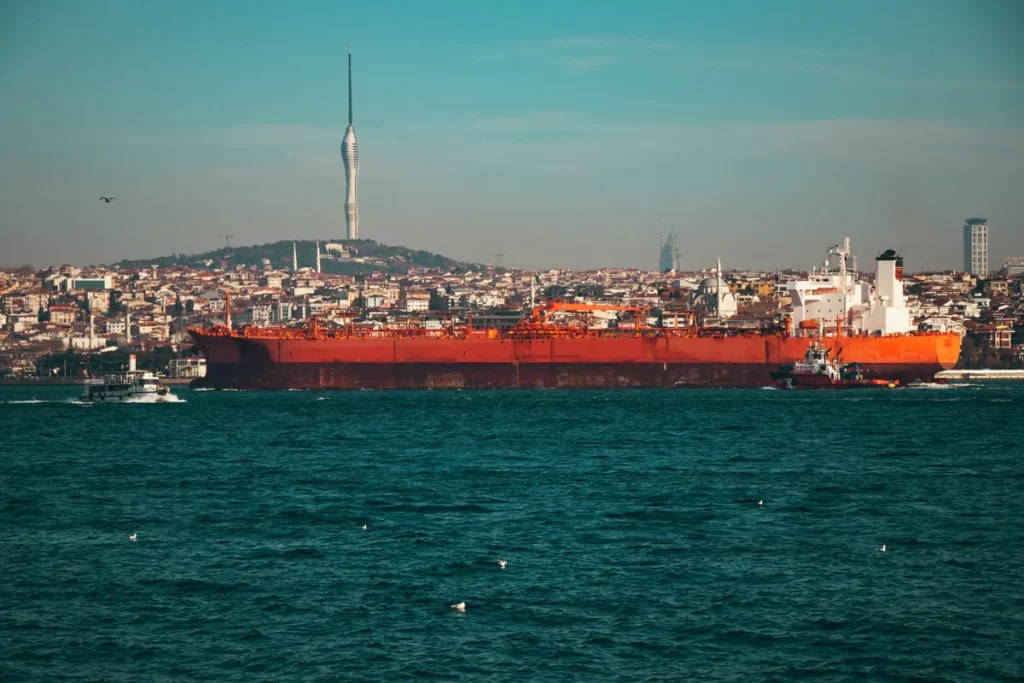

The Brent crude oil price dropped more than 9% on Monday, falling below $88 a barrel, after the United States and Iran signalled a second consecutive night of halted attacks to allow diplomatic talks to proceed.
That is a sharp reversal from last week, when Brent had climbed above $100 a barrel for the first time since May, driven by fears that the conflict would choke off global energy supplies through one of the world’s most critical shipping passages.
Why the Strait of Hormuz Makes the Brent Crude Oil Price So Volatile
The conflict’s grip on markets stems almost entirely from geography. The Strait of Hormuz is the narrow waterway between Iran and Oman through which, according to the Congressional Research Service, approximately 20 million barrels per day of crude oil and petroleum products flowed in 2024, representing roughly 27% of all global maritime oil trade.
The outbreak of fighting led to the effective closure of the strait, triggering the initial price spike. When the US and Iran signed a memorandum of understanding in June to halt military operations and reopen the waterway, Brent fell back to around $70 a barrel. The collapse of that ceasefire earlier this month pushed it back up, with Liveindex price data showing a three-month average high of $126.31 per barrel during the period of active conflict.
The stakes extend well beyond Europe and the Americas. According to the U.S. Energy Information Administration (EIA), 84% of the crude oil and condensate that moved through the strait in 2024 was destined for Asian markets, as was 83% of the liquefied natural gas (LNG). China, India, Japan, and South Korea alone accounted for a combined 69% of all Hormuz crude flows.
BBC News, citing US government figures, reports that Qatar exported approximately 9.3 billion cubic feet per day of LNG through the strait in 2024, with the UAE adding a further approximately 0.7 billion cubic feet per day. Any sustained disruption is therefore as much an Asian energy crisis as it is a Middle Eastern one.
Cautious Relief, Not a Verdict
Monday’s price fall reflects hope, not resolution. The US ambassador to the United Nations said attacks on Iran had been paused for a second consecutive night to give talks some space. An Iranian army spokesperson confirmed on Sunday that Tehran had halted what it described as retaliatory attacks in the region.
Susannah Streeter, chief investment strategist at Wealth Club, captured the mood precisely. Markets were remaining ‘cautious given the twists and turns during this conflict,’ she said. Despite the sharp fall in crude, ‘there is still significant uncertainty baked into these prices and a reticence about whether negotiations will lead to a lasting breakthrough.’
She is right to be cautious. The ceasefire signed in June collapsed, and the Houthi attacks on oil tankers in the Red Sea last week added a second pressure point: Saudi Arabia had been routing crude exports through the Red Sea to bypass the closed strait entirely, and those tanker strikes threatened that workaround too.
A fuel price drop at the pump, and some easing of food inflation driven by higher transport costs, depends on whether this pause becomes a pattern. The question now is whether two nights of quiet can survive the third.
