

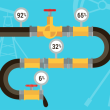




Private infrastructure funds command more than $4.5 trillion in global capital, yet America’s essential infrastructure continues to deteriorate faster than government resources can address. The disconnect between available private capital and persistent public funding shortfalls has created opportunities for specialized firms to support infrastructure renewal through targeted investment strategies across multiple categories.
The Infrastructure Investment and Jobs Act allocated $1.2 trillion over five years, but the American Society of Civil Engineers estimates the nation requires $9.1 trillion to bring infrastructure into a state of good repair by 2033. Even with recent federal commitments, a $3.7 trillion investment gap remains—underscoring the challenge of relying solely on public funding.
“The money doesn’t exist for these repairs, and time is running out to get them done,” warned Bob Hellman, CEO of American Infrastructure Partners, in a recent analysis of infrastructure funding. “Waiting for the next bridge collapse to respond is not a sign of sound decision-making or responsible leadership.”
This funding reality has shifted the role of private infrastructure capital. While traditional infrastructure funds invest broadly across global assets, specialized firms like American Infrastructure have developed a platform-based approach that concentrates expertise and capital within specific infrastructure sectors.
Government Projects Plagued by Cost Overruns
Traditional government-led infrastructure projects have often experienced budget escalation and schedule delays. Boston’s Big Dig exceeded its original budget by over 600%, while California’s high-speed rail project is tracking toward at least 300% cost overruns. The Gordie Howe Bridge connecting the United States and Canada is now estimated at 127% above its original projections.
These overruns reflect structural challenges within public project delivery. Local governments may not have the in-house expertise or experience needed for large-scale infrastructure development, which can lead to difficulties in managing costs and timelines.
“When a local government tries to conduct a big infrastructure project, it may be the first bridge that a mayor has ever built,” Hellman says.
Private infrastructure platforms can offer concentrated experience developed through repeated project cycles. Specialized firms may build dedicated teams focused on particular infrastructure challenges, such as bridges, schools, or broadband, providing additional support to public sector partners. This structure can help improve project planning and execution through a more consistent operational model.
Efficiency advantages may also extend into long-term operations. While government agencies often face budget constraints that can delay maintenance, private operators typically maintain financial incentives to preserve asset quality throughout the lifecycle. This long-term stewardship model may support infrastructure performance and durability when aligned with public goals.
Platform Strategy Delivers Concentrated Expertise
The disconnect between infrastructure needs and capital availability has prompted new approaches to private infrastructure investment. Rather than deploying capital across diverse sectors, American Infrastructure has created dedicated platform companies—each focused on one major infrastructure category.
“What we’ve done is turn the entire business model on its head. We said, we’re to build platform entities with dedicated teams of people and dedicated pools of capital each focused on one major infrastructure problem in America,” says Hellman.
Each platform begins by identifying a key infrastructure challenge facing American communities. Infrastructure investment leaders have developed specialized teams and capital structures to address the nation’s 42,067 structurally deficient bridges, aging postal facility networks, and K–12 schools that collectively require an estimated $1.1 trillion in upgrades over the next decade.
This targeted approach has already supported multiple large-scale projects. United Bridge Partners (UBP), the firm’s bridge-focused platform, has completed four bridge projects valued at over $100 million each within four years—representing a meaningful portion of bridge activity in that size range during the same period. The Jordan Bridge in Chesapeake, Virginia, for example, was completed at a cost of $143 million—below the state’s initial projection of $200 million—while also enabling adjacent park improvements.
UBP’s Houbolt Road Extension in Joliet, Illinois, is another example. The privately financed bridge created direct Interstate 80 access from CenterPoint Intermodal Center, reducing truck idle time by 20,540 hours annually and helping cut carbon emissions by approximately 240.5 metric tons per year.
How Market Forces Drive Infrastructure Innovation
The scale of America’s infrastructure deterioration has created what economists call a market failure—a condition where public mechanisms struggle to allocate capital efficiently to meet essential societal needs. This challenge is evident across categories, from bridges to the estimated $690 billion wastewater funding gap.
“Private infrastructure brings together deep-pocketed investors and those with the know-how to build projects on time and on budget,” said Hellman.
The strength of this model lies not only in access to capital, but also in operational experience. Firms with concentrated focus can apply lessons from prior projects to help structure, manage, and execute new ones more effectively.
Climate change adds another layer of urgency. The ASCE report highlights how extreme weather increasingly strains infrastructure systems built for past climate conditions. In this environment, private platforms may be well-positioned to incorporate resilience measures that align with both long-term asset value and community needs.
The combination of aging infrastructure and available private capital has opened the door to innovation in both delivery and financing. Historically, most infrastructure development relied on government-led design and oversight. While effective in many cases, this process can involve long timelines and coordination challenges. Private operators—when invited to partner—can offer integrated models that streamline steps and complement public oversight.
The viability of this model ultimately depends on policy frameworks that support private-sector involvement while protecting public interests. Infrastructure investors like American Infrastructure have aimed to demonstrate how projects can align financial sustainability with community impact through long-term collaboration and responsible planning.