


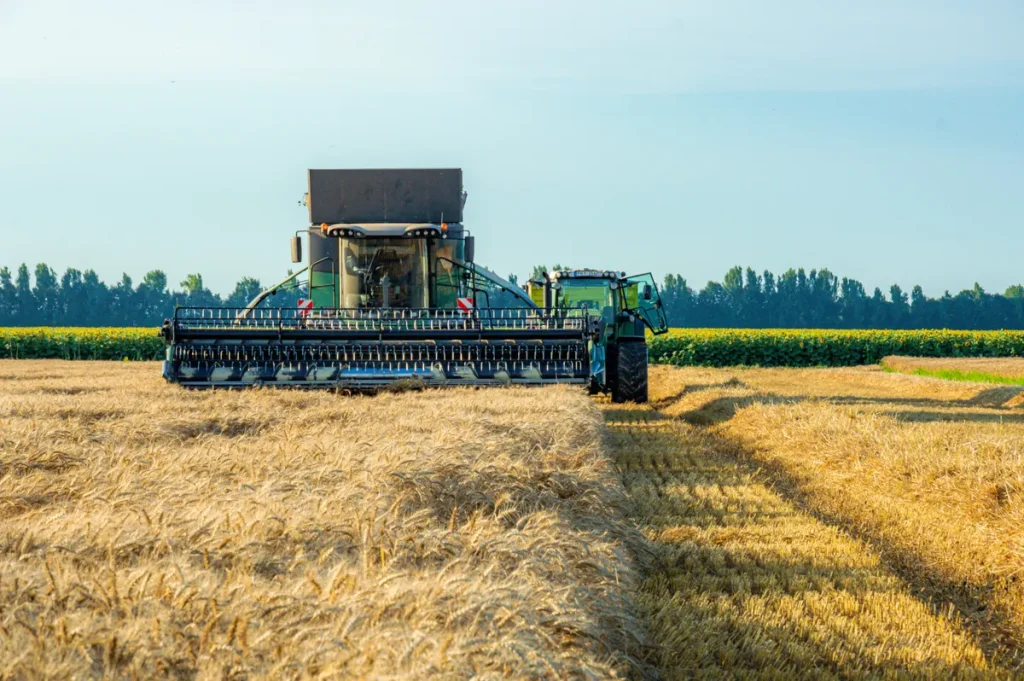

UK shop price inflation hit its highest level in two years in August, with in-store prices rising 1.5% year on year, up from 0.9% in July, according to the British Retail Consortium’s BRC-NIQ Shop Price Index. Two forces are doing the damage: soaring energy costs feeding through into processed and ambient food, and a cereal harvest that has come in well below par.
Tinned and packaged food led the charge, rising 2.5% against 1.1% in July. Fresh produce inflation held at 3%, easing only fractionally from 3.1% the prior month, as growers absorbed punishing fuel costs on top of a hot, dry summer that reduced yields.
UK Shop Price Inflation and the Harvest Crisis
The harvest picture explains a good deal of the food pressure. Farm Contractor Magazine, reporting on the first Agriculture and Horticulture Development Board (AHDB) harvest update of 2026, noted that only 54% of the wheat area had been cut at that stage, with average yields of 6.8 tonnes per hectare. For context, the AHDB’s final 2025 harvest report put the GB average wheat yield at 7.6 t/ha, per BritFarmers.
By the time 85% of the wheat area had been cut, average yields were running 13% below the five-year average, according to a later AHDB update. A separate report from Farmers Guide put the deficit at around 12%, reflecting a slightly earlier reporting date. The direction is unambiguous either way.
The deterioration was visible even before harvest began. The Scottish Farmer reported that the proportion of winter wheat rated good or excellent fell from 74% in April to 58% as the spring turned hostile. The Agriculture and Horticulture Development Board had flagged that wheat and barley were hit particularly badly, with the hot weather producing the earliest harvest since records began in 2006.
Helen Dickinson, chief executive of the British Retail Consortium, was direct about the mechanism: ‘The impact of higher energy, input and commodity costs is beginning to filter through into prices, particularly for ambient foods which are typically imported and processed.’
It is not only food. Dickinson added that electrical prices rose ‘amid the ongoing AI boom, which is forcing up the price of memory chips and storage,’ while clothing was kept deliberately cheap ahead of the back-to-school season.
Broader Inflation Is Moving in the Wrong Direction Too
The shop price figures sit inside a broader inflationary uptick. The UK Consumer Prices Index (CPI) rose to 3.1% in the 12 months to August 2026, up from 2.9% in July, according to the Office for National Statistics (ONS). The Consumer Prices Index including owner occupiers’ housing costs (CPIH) rose to 3.3% over the same period, also per the ONS.
The ONS had released the July CPI figure on 19 August 2026, with the August data following on 16 September 2026. Energy has been the primary driver: gas and electricity costs pushed CPI higher in July, and despite government measures, households in Great Britain face the sharpest summer increase in energy bills in four years.
Mike Watkins, head of retailer insight at NIQ, said he expected price competition between retailers to intensify in the autumn months as businesses competed to attract families concerned about potentially higher energy bills. That is a reasonable prediction, but Dickinson’s caveat deserves equal weight: companies are facing ‘persistently high operating costs’ that limit their ability to absorb price rises.
The BRC-NIQ index tracks price changes across 500 commonly bought products in seven sectors, from food and electrical goods to clothing and furniture, with roughly 6,500 to 7,000 price points collected each period. It is a wide-angle lens, and right now every sector in that field of view is under pressure.
Dickinson’s message to government was unambiguous: ‘If the government is serious about supporting growth while keeping the cost of living in check, it must address the cost of doing business, including by tackling the growing burden of business rates, packaging and employment taxes.’ With CPI at 3.1% in August and the harvest delivering yields well below the five-year average, the autumn price data will show whether retailers can absorb any more, or whether shoppers pay instead.
