


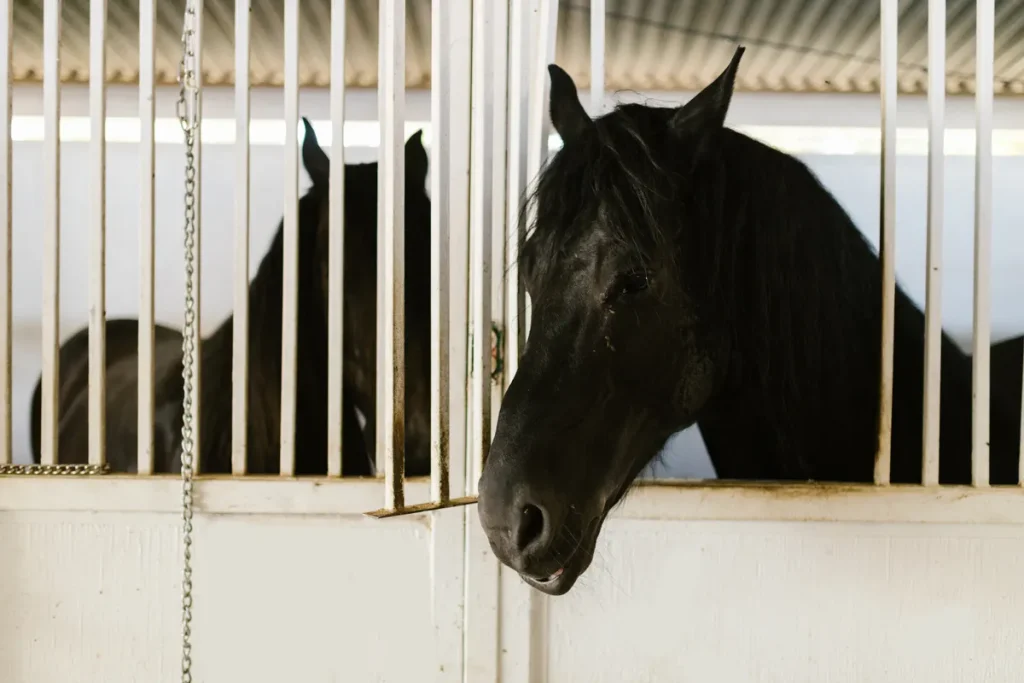

Blue Cross is taking in horses surrendered to its care at a rate of 20 to 30 a month at its Burford, Oxfordshire centre, as the charity records a 160% surge in relinquished horses in recent years across its UK operations.
The immediate pressure is a dry summer that has stripped pastures bare and driven hay prices higher. But that is the accelerant, not the cause. The deeper problem is structural, and it long predates the current weather.
The Rising Cost Behind Horses Surrendered to Blue Cross
Admissions coordinator Freya Long describes what she is seeing on the ground. ‘There’s no grass, very little hay. I’ve started getting an increase in requests and I can only imagine it’ll get higher with the cost of living,’ she said.
The costs that tip owners over the edge go well beyond feed. Veterinary care, vaccinations, worming and farrier visits are all recurring, non-negotiable expenses that accumulate regardless of whether a horse is competing or simply kept as a companion animal.
Horse centre manager Vicki Alford is direct about what that means in practice: ‘It all adds up. We are finding, unfortunately, that people are contacting us because they can’t financially look after their horses anymore.’
Owners who feel they have reached the limit can contact the Blue Cross rehoming centre in Burford by email or by phone on 0300 777 1846. The charity is explicit that it will not judge.
A Crisis the RSPCA Traces Back to 2012
The scale of horses surrendered to Blue Cross reflects a welfare emergency the RSPCA‘s 2025 equine welfare report traces back to 2012, when overbreeding, abandonment and neglect first converged into what campaigners began calling the horse crisis. By 2025, the report found, the nature of the problem had shifted: from acute abandonment to more diffuse, everyday welfare failures driven by owner knowledge gaps, unsuitable facilities, and a persistent failure to plan for the true lifetime cost of horse ownership.
Three unmet needs run through those failures, framed in the report around what it calls the ‘Three Fs’: Forage, Friends and Freedom. Facilities that deny horses adequate turnout, grazing and socialisation are identified as a key structural driver, operating alongside cost pressures that the RSPCA found have been compounded by years of rising living costs.
The RSPCA’s report, whose findings are summarised by the Livery List Yard Owner Hub, calls on national governments to strengthen legislation, support local enforcement, and introduce regulation of livery yards and licensing of rescue and sanctuary operations. Colleges and equestrian organisations are also urged to close the practical skills gap that leaves new owners underprepared.
Come Before the Problem Becomes Critical, Says Blue Cross
The charity’s message to anyone struggling is to make contact early, before welfare begins to suffer. ‘We absolutely encourage this, we want people to come to us…before their horses get too far down the line. Please come to us. We are here to help and we will not judge,’ Alford said.
The charity’s operations and finances are set out in its Blue Cross annual reports, with the most recent edition covering 2024.
My read is that voluntary organisations are absorbing what is, at root, a legislative failure. At the current rate of horses surrendered to Blue Cross’s Burford centre alone, charitable capacity is being stretched by a flow of animals that the system of ownership, breeding and resale created but never planned to catch. Whether a welfare charity’s phone line is the right answer to that problem is a question the RSPCA’s report puts squarely to government, and one that deserves a serious reply.
