


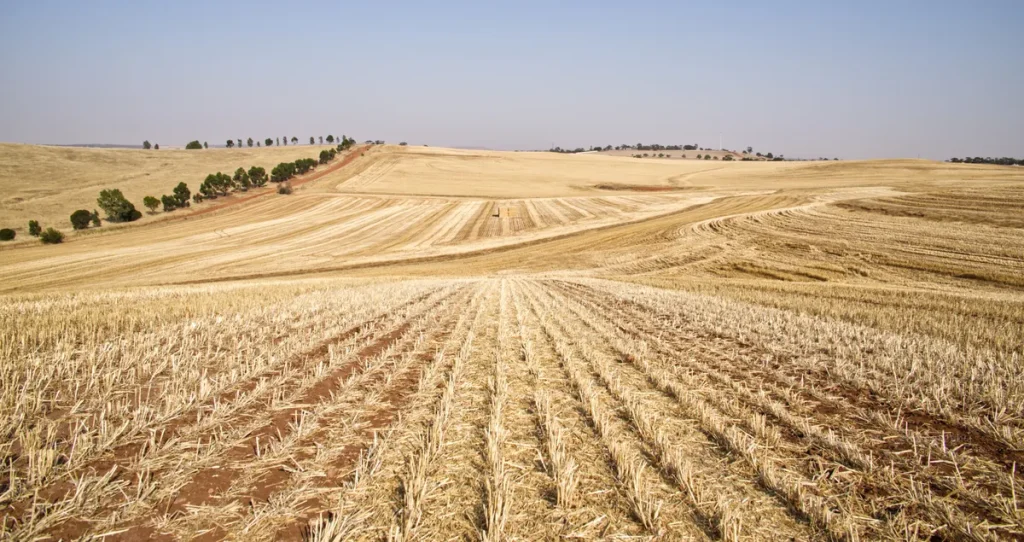

The drought food price rise now facing British shoppers is not a hypothetical threat: it is already baked into the supply chain, from scorched wheat fields to supermarket shelves. The Environment Agency declared drought across more than half of England last week, covering seven areas, East Anglia, Hertfordshire and London, the Thames Valley, Hampshire and the Isle of Wight, Devon and Cornwall, the West Midlands, and Wessex. It is the third drought England has experienced in just five years, following those of 2022 and 2025.
The speed of the deterioration has caught even specialists off guard. BBC News reports the Environment Agency has described this as a ‘flash drought’: one that arrived suddenly rather than accumulating over months, driven by low rainfall combined with prolonged high temperatures that accelerated evaporation. More than 20 million people in England are already subject to hosepipe bans, with North Wales and the Upper Severn river basin also entering drought conditions according to Natural Resources Wales.
What the Failed Harvest Means for Drought Food Price Rises
The clearest signal of what is coming sits in the fields. NFU president Tom Bradshaw said yields of wheat and oats were ‘very, very poor’ this year. Livestock farmers, he warned, have had to dip into their winter feed rations because they have been unable to grow grass. That kind of double pressure, a ruined arable crop and depleted fodder reserves, tends to run through food costs for months after the harvest itself.
Farmers and flour producers are already adapting to what they describe as the earliest harvest in 50 years. The National Farmers’ Union has warned that shortages of certain food products are possible if drought conditions persist. These are not small variables at the edge of the supply chain. Bread, dairy, meat: each depends directly on what is happening in fields right now.
It is worth remembering that last year’s problems ran in the opposite direction. The Guardian reported that wet weather during key planting periods cost UK farmers almost £1.2 billion from arable crop damage in 2024. Too wet, then too dry: the pattern is consistent even if the weather is not, and the bill lands with the consumer either way.
Retailers Are Already Warning on Inflation
The British Retail Consortium (BRC) has been direct about where this leads. The BRC warned that food inflation will remain above 5% well into 2026 if the retail industry faces additional cost pressures, with chief executive Helen Dickinson pointing to a trend ‘accelerated by geopolitical tensions and impacts of climate change.’ Drought sits squarely inside that second category.
Shoppers are already feeling it. A survey of 2,000 people conducted by Opinium for the BRC found that 57% of respondents, rising to 61% among working individuals, identified ‘prices rising faster than wages’ as their primary concern for the year ahead. That figure outpaced worries about tax increases (49%) and rising unemployment (26%), according to Yahoo Finance UK.
The fourth heatwave of the year was expected to peak at up to 35°C, with the UK Health Security Agency issuing an amber heat-health alert for the East Midlands, East of England, South East, and London, according to Reuters Connect. The heat is not just uncomfortable for people; every additional day of it compounds the moisture deficit in the soil.
The drought food price rise question is really a question of timing. The harvest damage is done. The NFU’s warning about shortages is conditional on drought conditions continuing, but the early harvest data gives little reason for optimism. Watch the autumn inflation prints: that is where the field losses of this summer will show up in numbers that shoppers cannot ignore.
